In Focus: Private Military Contractors
Prepared by the RAND Corporation | January 2021
|
 |
|
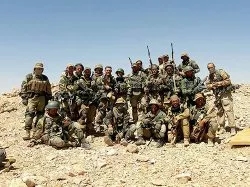
Members of the Wagner Group in Syria circa 2018
(photo courtesy of the Security Service of Ukraine)
|
This newsletter captures a selection of open source material on malign activities by Private Military Contractors (PMCs). The International Committee of the Red Cross defines PMCs as private businesses providing military and security services. These services include armed guarding, maintenance and operation of weapons systems, prisoner detention, and advice or training to local forces or security personnel. In the context of this newsletter, malign activities are those activities undertaken by a PMC which are illegal, destabilizing, or escalatory. The RAND Corporation gathers this open source material with the support of U.S. government foreign assistance funding.
|
|
|
|
|
|
The Pendulum: How Russia Sways Its Way to More Influence in Libya
01/07/2021 | War on the Rocks
Russia, Turkey, and the United Arab Emirates (UAE) are the three countries most involved in Libya's conflict. Libya is an attractive target for foreign intervention due to its strategically important location and its vast reserves of natural resources, including oil. Prior to Moammar Gadhafi's overthrow in 2011, Russia had roughly $6.5 billion in official and unofficial contracts in Libya, and Russia's involvement in Libya is in part tied to its wish to regain its economic foot in Libya. Russian PMCs have most likely been active in Libya since 2016, and the international press first reported on the presence of a Russian PMC, the RSB Group which was charged with providing security and demining services to Field Marshall Haftar's forces, in 2017. The Russian Wagner Group became involved in Libya during the first half of 2018 and began provide training, hardware, non-kinetic security services, and battlefield advice to Haftar's forces. Shortly after Wagner became involved in Libya, Haftar's forces began to advance from its base in the eastern province of Cyrenaica towards Tripolitania where the capital of Tripoli is located. However, following Haftar's failure to capture Tripoli, Russian mercenaries have withdrawn back to northwestern Libya. However, Wagner has continued to supply a limited number of troops as well as equipment to Libya. Wagner's status as a non-official representative of Russian power in Libya has made it difficult for both Haftar and other international powers in Libya to force Wagner to give up territory and natural resources gained by Wagner as there are no official diplomatic channels through which Moscow could be pressured.
|
|
Near East (Middle East and North Africa)
|
|
|
Wagner Group to Support 2 Russians Freed in Libya
12/15/2020 | Anadolu
Yevgeny Prigozhin, owner of the Russian private military company Wagner Group, will pay $488,000 for two Russian citizens who were detained in Libya in 2019 on spying charges. According to Prigozhin's catering company Concord, Maxim Shugaley and Samer Hasen Ali Sueyfan were released on December 10, 2020, after 18 months in prison and have returned to Russia. The Russian government argued that the two men were academic researchers affiliated with a think tank, but the Libyan Government of National Accord stated that they were intelligence agents conducting field research for Wagner Group.
Iraq: Trump Pardons for Baghdad Blackwater Gurads "Contributes to Impunity" Says UN Rights Office
12/23/2020 | UN News
The UN human rights office OHCHR condemned the pardoning of four Blackwater PMC employees who took part in the killings that took place when they and other guards opened fire in Nisoor Square in Iraq. OHCHR spokesperson Marta Hurtado stated that the pardon "contributes to impunity and has the effect of emboldening others to commit such crimes in the future." In 2014, a U.S. federal court found the men guilty of murder in one case, while three were convicted of voluntary manslaughter, attempted manslaughter, and other charges. The men were part of a Blackwater team guarding a U.S. diplomatic convoy when they opened fire at a busy roundabout, killing 14 people, including two boys aged nine and 11.
Foreign Fighters Were Meant to Leave Libya This Week. A Huge Trench Being Dug by Russian-Backed Mercenaries Indicates They Plan to Stay
01/22/2020 | CNN
Construction of a trench dug across Libya by Wagner Group is raising ears that foreign fighters will not withdraw from Libya by January 23, 2021, the date on which all foreign fighters must leave according to a UN-brokered peace deal. A U.S. intelligence official stated that this may be an indication that the Wagner Group is "settling in for the long haul" in Libya. The trench, which may be a series of trenches, extends roughly 70 km (43 miles) south of the Libyan coastal city of Sirte towards the Al Jufra Air Base. Images also show a buildup of defenses around the Al Jufra and Brak airfields, which are used by Russian Wagner mercenaries. Satellite imagery of the al-Khoms port shows minor modifications that suggest that the port may be being readied for a longer-term Turkish naval presence. Turkey has flown in thousands of Syrian mercenaries to combat LNA leader Khalifa Haftar, who is supported by Russia and the Wagner Group.
It's Syrian vs. Syrian in Libya
05/05/2020 | Foreign Policy
Russia and Turkey are both using Syrian mercenaries to fight on opposite sides of the Libyan Civil War. Syrians have joined mercenary groups, including the Russian Wagner PMC, due to lack of opportunities in Syria due to that country's civil war. Turkey has provided relatively high salaries, worth $2,000 a month, to Syrian mercenaries in Libya and has also provided drones and air defense systems to Libya. Russian recruitment efforts have been lead by Col. Aleksandr Zorin, who in 2016 served as the Russian Ministry of Defense's envoy to negotiations in Geneva on ceasing hostilities in Syria. The Syrian mercenaries were lured by the Russians with promises of high salaries - worth between $1,000 and $5,000 per month - and the promise that they would be guarding oil installations in Haftar-controlled eastern Libya. However, once the Syrian mercenaries were in Libya, they were told that they would be fighting for Haftar and would only be paid $200 per month.
Sudanese Demand UAE Apology over Haftar Recruitment
07/14/2020 | Al Jazeera
Hundreds of Sudanese protested outside the United Arab Emirates embassy in Khartoum against a dubious recruitment drive to fight for Khalifa Haftar in Libya. Demonstrators demanded an "apology and compensation" from the UAE authorities for being deceived by Emirati company Black Shield Security Services and forced to serve in Haftar's militias instead of the jobs promised as ordinary security guards. Black Shield Security has previously denied allegations of lying to Sudanese nationals about the nature of their expected work in Libya.
Pentagon Says UAE Possibly Funding Russia's Shadowy Mercenaries in Libya
11/30/2020 | Foreign Policy
The United Arab Emirates is helping to finance the Russian Wagner Group in Libya, according to a report issued by the Pentagon's Inspector General for counterterrorism operations in Africa. Experts have long suspected that the UAE may be using Russian private military contractors to help obfuscate its roles in the conflict, a charge that the UAE denies. According to Emirati Ambassador to the United Staes Yousef Al Otaiba, the "UAE is not financing and has never financed the Wagner Group."
Russia's Escalating Use of Private Military Companies in Africa
11/24/2020 | Institute for National Strategic Studies
Since 2017, Russia has increasingly relied on PMCs to function as its proxies in Africa. Russian PMCs are active in Sudan, the Central African Republic, Madagascar, Mozambique, and Libya. Activities undertaken by Russian PMCs in Africa include training local forces, providing security for Russian businesses, supporting political meddling, participating in combat, and receiving official military equipment transfers. Russian PMCs also gain natural resource concessions through their security work in Africa. The Wagner Group, Russia's most infamous PMC, is active in Africa, but its various campaigns have had various levels of success. In Mozambique, Wagner's mercenaries were overwhelmed by Islamic insurgents and possibly withdrew from the country due to this poor performance. In Libya, the Wagner Group has received more blatant support from the Russian government, including receiving official arms transfers from Russia. Russian PMC involvement in Libya also indicates Russia's willingness to use PMCs to fight in direct contravention of UN resolutions and international law.
|
|
|
The Militiary-First Approach in Northern Mozambique Is Bound to Fail
11/23/2020 | Council on Foreign Relations
Both Russia's Wagner PMC and South Africa's Dyck Advisory Group PMC have been involved in the effort to counter the Islamist insurgency in Mozambique. In September 2019, the Wagner Group was deployed to Cabo Delgado, Mozambique's worst-afflicted province and the site of the largest private investment in Africa. By Novemberr 2019, the Wagner Group mercenaries were evacuated after sustaining losses. They were replaced by South African PMC Dyck Advisory Group, which remains in Cabo Delgado but has been unable to subdue the insurgency. Mozambique's government has not taken any steps to investigate human rights abuses committed by PMCs within Cabo Delgado.
Mozambique: Mercenaries to the Fore as Dyck Contract Extended
07/27/2020 | allAfrica
Mozambique has extended and expanded South African PMC Dyck Advisory Group's three month contract. Dyck Advisory Group is run by Lionel Dyck, who fought in Rhodesia and other conflicts across Africa. Most of the mercenaries employed by Dyck Advisory Group also fought for either Rhodesia or apartheid South Africa before more recently turning to PMC work. Dyck Advisory Group too small to carry out effective ground operations, instead relying on helicopters to surround groups of rebels and prevent them from escaping by shooting them down.
Mozambique's Northern Insurgency Continues to Rage
10/18/2020 | Foreign Brief
Despite engaging both Russian PMC Wagner Group and South African PMC Dyck Advisory Group, the government of Mozambique has been unsuccessful at countering the Islamist insurgency in the northern region of Cabo Delgado. The Wagner PMC was forced to pull back in November 2019 after insurgent infiltrators carried out a series of ambushes. Dyck Advisory Group has also been stymied by astute insurgent tactics, inadequate intelligence lines, and the enormous distances between its bases and target areas. As a result, the government of Mozambique is considering pivoting towards non-military tactics to counter the insurgency. These solutions include negotiations with the Ansar al-Sunna group and socio-economic investment into the Cabo Delgado region. However, these measures will most likely be inadequate to stem the conflict at this point in time.
Why African Governments Still Hire Mercenaries
5/28/2020 | The Economist
Countries in Africa have recently turned towards PMCs to help counter insurgencies, prop up governments, and protect economic assets. In the years after most African countries gained independence, mercenaries were primarily used to support seccessionist movements and mount coups. Western governments have in the past allowed mercenary activity that served their commercial interess, but Russia has recently expanded its use of PMCs in Africa, leading to concerns about increased Russian influence in Africa. Other prominent PMCs in Africa, such as Dyck Advisory Group and OAM Middle East, are run by veterans of the wars supporting apartheid and white-run states such as Rhodesia. African countries facing security threats have turned to PMCs due to their relative low cost and efficiency.
Russia's Growing Military Presence in the Central African Republic
01/20/2021 | Jamestown Foundation
Russia has increased its presence in the Central Afriican Republic following the capture of two strategically important cities, Mbaiki and Boda, by rebels. The Central African Republic's spokesperson Ange Maxime Kazagui stated that several hundred Russian and Rwandan military personnel were transferred to the Central African Republic. Russia's Ministry of Foreign Affairs confirmed that additional Russian personnel were sent to the Central African Republic but emphasized that the personnel would only be used to train and provide consultations to the local militia and armed forces.
Outside Powers Are Making the Conflict in the Central African Republic Worse
01/22/2021 | Foreign Policy
Following presidential elections on December 27, 2020, tensions in the Central African Republic, fuelled by foreign interferrence, have risen. After the CAR's consitutitional court invalidated former President Francois Bozize's candidacy, a rebel alliance supporting Bozize captured towns near CAR's capital of Bangui. Mercenaries from Russia and Rwanda responded on behalf of the CAR's government, while France and Chad supported Bozize. As a result, Russia and France have become locked in a proxy war in the CAR as Russia attempts to undermine France's influence in its former colonies. The situation is further complicated by competing regional interests in CAR, including Chadian interest in the conflict due to cattle investments made by the country's elites. Furthermore, international organizations, including the UN, have tentatively backed the country's flawed elections and have failed to supply funding needed to counter humanitarian crises, including the COVID-19 pandemic. As a result, the situation in CAR has become increasingly unstable.
SA Arms Sold in Mozambique
01/24/2021 | Sunday Times (South Africa)
South African paramilitary companies, including Paramount Group and the Dyck Advisory Group, are supplying the Maputo government with armored vehicles, combat helicopters, weapons, ammunition, training, and private security contractors. Actions by these South African PMCs allegedly violate South Africa's Prohition of Mercenary Activities Act and the Regulation of Foreign Military Assistance Act. Dyck Advisory Group has been flying combat helicopter missions in support of Mozambique's ground forces since September 2020. Paramount Group is training Mozambican forces outside of Polokwane in Limpopo and equipping them with armored vehicles. According to Cyril Xaba, the co-chair of the South African parliament's joint standing committee on defense, any support from South African companies or citizens to Mozambique would be illegal as it would be in violation of the national conventional arms control committee regulations.
|
|
|
Ukraine's Former President Confirms Kyiv's Involvement in Bringing Suspected Russian Mercenaries to Belarus
12/31/2020 | Meduza
Ukraine's former president Petro Poroshenko has confirmed hat the 33 suspected Russian mercenaries from the Wagner PMC who were arrested in Belarus in June were lured from Russia as part of a special operation carried out by the Ukrainian intelligence services. Poroshenko stated that he personally authorized the operation at the end of 2018, but the operation fell through following Volodymyr Zelensky's ascendency to the presidency due to the betrayal of several individuals in the Ukrainian leadership.
Russia's Use of Its Private Military Companies
12/23/2020 | IISS Strategic Comments
Russia has pivoted towards the use of PMCs as they are less costly to operate both politically and economically and they provide a level of deniability to the Russian government. As a result, Russia has increased its number of interventions abroad. Russian PMCs were first used in 2014 during Russia's takeover of Crimea and intervention in the Donbas. Following the deployment of Russian PMCs in 2015 to Syria, PMCs began to offer contract services to governments in sub-Saharan Africa, including the CAR, the Democratic Republic of Congo, and Sudan. Since 2019, Russian PMCs have been active in Libya, Madagascar, Sri Lanka, and Venezuela. Unlike Western PMCs, Russian PMCs often use their soldiers to project hard combat power, blurring the lines between activities attributable to PMCs and those attributable to the Russian government. Russia has also used PMCs to spread political and economic influence. These operations include the use of Wagner-run social media accounts to garner support for the government in CAR and the acquisition of revenue from oil and gas fields recovered from ISIS in Syria. Due to the low cost and relative success of these operations, Russia will most likely continue to use PMCs as proxies in foreign conflicts.
|
|
East Asia and the Pacific
|
|
|
Frequently Asked Questions: Chinese Military Companies Sanctions
01/06/2021 | Office of Foreign Assets Control
This is an update of the Office of Foreign Assets Control's frequently asked questions on Chinese military companies sanctions. The OFAC FAQ answer also includes a PDF list of the sanctioned Chinese security companies.
|
|
|
Onset of New Business? Private Military and Security Companies and Conflict Onset in Latin America, Africa, and Southeast Asia from 1990 to 2021
01/07/2021 | Small Wars & Insurgencies
The article analyzes whether the use of PMSCs leads to an increase or decrease in conflicts, particularly civil wars, in the areas in which they are used. There are two conficting theories about the effect of the PMSC market of force on the spread of conflicts. The first posits that the market of force will lead to a neo-medieval order in which the threshold for military use is lowered as any actor is able to contract for warfare sources, leading to continual conflicts. The second theory posits that by providing tools to strengthen weak governments, PMSCs help to decrease conflict liklihood. Two statistical models, the Cox proportional hazards model and a logistic regression model, are used to analyze the Private Security Events Database (PSED) to determine whether the use of PMSCs increases the likelihood of conflict onset. The statistical models support the conclusion that PMSCs increase the likelihood of conflict onset but that the magnitude of the effect is small. In general, conflict onset became increasingly likely the longer a PMSC was in a country, the more PMSCs were present in a country, and if a PMSC was hired by a government.
|
|
|
