In Focus: Private Military Contractors
Prepared by the RAND Corporation | February 2021
|
 |
|
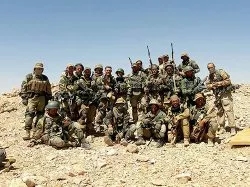
Members of the Wagner Group in Syria circa 2018
(photo courtesy of the Security Service of Ukraine)
|
This newsletter captures a selection of open source material on malign activities by Private Military Contractors (PMCs). The International Committee of the Red Cross defines PMCs as private businesses providing military and security services. These services include armed guarding, maintenance and operation of weapons systems, prisoner detention, and advice or training to local forces or security personnel. In the context of this newsletter, malign activities are those activities undertaken by a PMC which are illegal, destabilizing, or escalatory. The RAND Corporation gathers this open source material with the support of U.S. government foreign assistance funding.
|
|
|
|
|
|
Russia's Strategy in the Central African Republic
February 12, 2021
|
RUSI
Russia has expanded its presence in the CAR due to an outbreak of violence following the country's presidential elections in December 2020. On December 22, 2020, Russia deployed an additional 300 military instructors to CAR. Russia announced the withdrawal of these instructors on January 15, 2021, following the reelection of Faustin-Archange Touadera. However, Russian PMC operators remain active in CAR, and on January 26, they helped CAR troops kill 44 rebels. Wagner Group PMCs also serve as bodyguards for CAR political elites. Russia's main objectives for its presence in CAR are to expand its diplomatic leverage and reduce French influence; to challenge UN-backed sanctions in CAR which threaten Russian commercial interests; and to use its presence in CAR as a springboard to expand influence throughout Central Africa. In particular, Russia hopes to expand its influence into the Democratic Republic of Congo and Rwanda based off of the success of its operations in CAR.
|
|
Near East (Middle East and North Africa)
|
|
|
UN Experts: Trump Ally, UAE Firms Violated Libya Sanction
February 20, 2021
|
The Washington Post
American security contractor Erik Prince violated the UN arms embargo against Libya along with three United Arab Emirates-based companies and their top managers during an operation to help Khalifa Haftar take Tripoli. The violations were part of Project Opus, which was designed to provide military equipment to Haftar and kidnap or kill individuals regarded as high-value targets in Libya. Project Opus was designed to have PMCs provide Haftar's forces with armed assault rotary wing aircraft, ISR aircraft, maritime interdiction, and intelligence and targeting capabilities. Three, unnamed UAE countries were involved in purchasing and transporting the arms to Libya.
The Conflict in Libya Is Getting Even Messier
February 04, 2021
|
Foreign Policy
The United Arab Emirates (UAE) has increased its activity within Libya, including reaching out directly to armed Sudanese groups fighting for Khalifa Haftar. According to the U.S. Department of Defense's inspector general for counterterrorism operations in Africa assessed that the UAE was possibly helping to fund the activities of Russia's Wagner Group in Libya. This claim was denied by the Emirati ambassador to the United States, Yousef Al Otaiba. Despite the signing of a peace deal in October 2020, foreign actors, including UAE, have remained active in Libya. Russian fighters have been digging defensive trenches in Libya, and UAE has continued its outreach to Sudanese fighters in Libya.
Al-Mismari Denies the Presence of Wagner Group in Sirte
January 31, 2021
|
Libyan Express
Haftar's official spokesman General Ahmed Al-Mismari denied the presence of Russian Wagner Group forces in the city of Sirte, stating that the city is completely under the control of Haftar. The announcement comes after recent satellite images obtained by CNN showed a trench running tens of kilometers and reportedly dug by Russian mercenaries, near the frontline coastal city of Sirte. The dismissal from Al-Mismari comes after anti-Wagner leaflets were found in Sirte, which Al-Mismari described as an attempt to spread fake news.
UN Chief Guterres Urges Foreign Fighters to Leave Libya
January 29, 2021
|
Daily Sabah
The UN Security Council and Secretary-General Antonio Guterres called on thousands of foreign fighters and mercenaries to immediately leave Libya after a deadline for them to depart was ignored. Guterres emphasized that the ceasefire in Libya was holding. The UN estimates that there are some 20,000 foreign troops and mercenaries in Libya, including troops from Turkey and Russian Wagner Group mercenaries. Russia denies the presence of Russian-backed mercenaries in Libya.
Pentagon Says UAE Possibly Funding Russia's Shadowy Mercenaries in Libya
November 30, 2020
|
Foreign Policy
According to a report published by the Pentagon's Inspector General, UAE is helping to finance the Russian Wagner Group in Libya. This is the first report that publicly confirms the role of the UAE in funding Wagner. Emirati Ambassador to the United States Yousef Al Otaiba denied the links between the UAE and the Wagner Group. Both UAE and the Wagner Group have provided support for Khalifa Haftar and the Libyan National Army (LNA).
Guys You're Destined for War' Combatant from the Russian Mercenary Group Tied to 'Putin's Chef' Grants Meduza the First Interview of Its Kind
December 02, 2020
|
Meduza
Meduza interviewed Marat Gabidullin, a former Wagner PMC mercenary who fought with the group for four years. Gabidullin worked in Syria protecting and liberate oil fields in Syria for the Syrian government. In his memoir, Gabidullin claims that contractors working with Wagner Group stole money from the company and its head Yevgeny Prigozhin after realizing that there was little pushback against the theft. Gabidullin also claimed that Wagner Group mercenaries, rather than regular Russian military, are the ones fighting in Syria and that, as a result, there is a large amount of resentment between the two organizations. Furthermore, Gabidullin claims that the Russian government attempted to obfuscate military losses as well as friendly fire attacks against Wagner in Syria.
|
|
|
Moscow's Mercenaries: How Russia Is Swelling the Global Market for Private Military Companies
February 17, 2021
|
Al Araby
The number and influence of mercenaries in Africa has increased in recent years. Russia has attempted to increase its influence in Africa through the use of mercenaries, particularly through the use of the Wagner Group. African countries are particularly attractive to Russia as they allow Russia to execute its "package of deals," which include arms sales, the use of PMCs, and political manipulations to shore up unstable regimes. Russia's Wagner Group has worked in several countries in Africa, including Sudan, CAR, Guinea, Libya, and Mozambique. PMCs also have advantages for states wishing to intervene in a foreign country as they are less expensive to operate than a traditional military and provide a degree of plausible deniability to the state.
Mozambique and the Fight Against Insurgency
February 08, 2021
|
Global Risk Insights
The government of Mozambique has applied to several foreign PMCs for assistance in fighting ISIS-linked rebels in its Cabo Delgado region. Russia's Wagner Group was the first PMC to arrive in Mozambique, but the Russians pulled out of Mozambique following the loss of seven members. Following the withdrawal of Wagner Group, the government of Mozambique hired the South African PMC Dyck Advisory Group. Dyck Advisory Group is headed by Lionel Dyck, a former colonel in the Rhodesian military. However, despite having experience operating within the region, Dyck Advisory Group has experienced difficulties executing operations, including losing a helicopter to enemy fire within the first weeks of operation. Dyck has been more successful in its operations than Wagner, and the government of Mozambique renewed its contract for operation by another eight months in July 2020. Dyck has consulted with South African PMC STTEP International regarding the operations in Mozambique. The government of Mozambique has also brought in South African aerospace and technology company Paramount Group to provide equipment and relevant training to Mozambique's military forces.
Russia Pulling 'Military Instructor' out of Central African Republic: Diplomats
January 15, 2021
|
Russia has told the United Nations this week that it plans to withdraw the 300 "military instructors" it sent to CAR at the end of 2020 for the presidential election. Russia initially denied sending regular forces but later acknowledged that it had sent at least 300 additional "military instructors". This term is often used to refer to paramilitaries from the Russian Wagner Group PMC.
Russia: How the Kremlin Is Gradually Overtaking Africa
December 06, 2020
|
Global Risk Insights
Russia's use of gray zone military capabilities, including PMCs, has strengthened the Kremlin's leverage to contest Chinese and American interests in Africa. The Wagner Group has been deployed in a number of African countries to help strongman governments quash civil unrest and retain their political positions. The Wagner Group has been active in the CAR to support the government during its December 2020 presidential and parliamentarian elections. The Wagner Group has also been active in Sudan both before and after the 2019 coup, and Sudan recently became the first African country in which Russia has launched a naval base. The Wagner Group has also been active in Zimbabwe, South Africa, Mozambique, Egypt, and Eritrea. The logistic and military support that PMCs have provided to African countries has allowed Russia to expand its exploitation of African natural resources and increase trade and economic ties within the continent.
RCA: CPC Rebels Claim to Have Taken Russian Mercenary Hostage (RCA: les rebelles de la CPC affirment avoir pris un mercenaire russe en otage)
February 15, 2021
|
CNC (Corbeau News Centrafrique)
Rebels from the Unit for Peace in the Central African Republic (UPC) and Patriots for Change (CPC) reported that they had taken a Russian mercenary hostage and killed several other Russian mercenaries in fighting that opposed government forces on February 10, 2021. The Russian Wagner Group mercenaries were supporting the Central African Armed Forces (FACA) in an operation to dismantle an illegal barrier erected by the rebels near Bambari.
|
|
|
The 'Wagner Affair' in Belarus and Its Implications for Ukraine
February 09, 2021
|
Jamestown Foundation
Different political factions within Ukraine have supported conflicting stories regarding the arrest of 33 Wagner operatives in Belarus last summer. Former Ukrainian president Petro Poroshenko stated that in 2018 he had authorized the operation for the arrest of the Wagner operatives but that the current administration had undermined its execution, leading to its failure during the summer of 2020. However, current Ukrainian president Volodymyr Zelenskyy and head of the Presidential Administration Andriy Yermak both stated that reports of a special operation for the capture of Wagner operatives involved in the fight in southeastern Ukraine were false. Several Ukrainian journalists, including Christo Grozev of Bellingcat and military journalist Yurii Butusov, have pushed back against Zelenskyy and Yermak's statements and emphasized that the new administration undermined the previous administration's plan to capture the Wagner operatives.
|
|
East Asia and the Pacific
|
|
|
Frequently Asked Questions: Chinese Military Companies Sanctions
01/06/2021 | Office of Foreign Assets Control
This is an update of the Office of Foreign Assets Control's frequently asked questions on Chinese military companies sanctions. The OFAC FAQ answer also includes a PDF list of the sanctioned Chinese security companies.
|
|
|
Onset of New Business? Private Military and Security Companies and Conflict Onset in Latin America, Africa, and Southeast Asia from 1990 to 2021
01/07/2021 | Small Wars & Insurgencies
The article analyzes whether the use of PMSCs leads to an increase or decrease in conflicts, particularly civil wars, in the areas in which they are used. There are two conficting theories about the effect of the PMSC market of force on the spread of conflicts. The first posits that the market of force will lead to a neo-medieval order in which the threshold for military use is lowered as any actor is able to contract for warfare sources, leading to continual conflicts. The second theory posits that by providing tools to strengthen weak governments, PMSCs help to decrease conflict liklihood. Two statistical models, the Cox proportional hazards model and a logistic regression model, are used to analyze the Private Security Events Database (PSED) to determine whether the use of PMSCs increases the likelihood of conflict onset. The statistical models support the conclusion that PMSCs increase the likelihood of conflict onset but that the magnitude of the effect is small. In general, conflict onset became increasingly likely the longer a PMSC was in a country, the more PMSCs were present in a country, and if a PMSC was hired by a government.
|
|
|
