
Monitoring and Surveillance of Behavioral Health in the Context of Public Health Emergencies
A Toolkit for Public Health Officials
Contents

1: Background and How to Use the Toolkit
Need for Improved Behavioral Health Surveillance in Public Health Emergencies
Behavioral health (BH) refers to a state of mental and emotional well-being and/or choices and actions that affect wellness. BH problems can include serious psychological distress, mental health conditions, suicidal ideation (SI) or suicide attempts, and substance use or substance use disorders. Public health emergencies (PHEs)—e.g., hurricanes, floods, and pandemics—can negatively affect population-level BH. For instance, rates of depression, anxiety, trauma-related symptoms, and substance use increased significantly in the United States after the onset of the coronavirus disease 2019 (COVID-19) pandemic (Ettman et al., 2020; Czeisler et al., 2020; Centers for Disease Control and Prevention [CDC], 2023). Although it is not possible to precisely predict individual-level BH trajectories, research suggests what you might expect at a population level during and after PHEs (Newnham et al., 2022). In the six months after a PHE, approximately one in four adults will develop clinically significant posttraumatic syndrome (PTSS) and anxiety, and about one in five adults will develop depressive symptoms. Over time, depression and anxiety prevalence remains elevated, but PTSS symptoms gradually improve. Children and adolescents follow similar patterns as adults but have higher rates of depression and anxiety (Newnham et al., 2022).
As of May 2023, no dedicated surveillance systems exist to track BH in the context of PHEs. During PHEs, data quality and availability may be compromised because of disruptions in health care delivery and other essential services, people being forced from their communities, or damage to infrastructure (such as power outages). Even outside emergency situations, data sources that contain information about BH have limitations, and few of these sources are routinely used for surveillance in the context of PHEs. Instead of a comprehensive surveillance system, public health (PH) officials rely on a patchwork of existing surveys and surveillance systems that all have limitations, including long lags between data collection and release, nonrepresentative sampling, and lack of validated measures (Council of State and Territorial Epidemiologists [CSTE], 2013).
However, there are a growing number of examples of jurisdictions that have incorporated BH indicators into their surveillance efforts in response to PHEs (see the button below). They could be places to watch for emerging promising practices and examples of how to take action based on information gleaned from BH surveillance.
 View a list of real-world examples of jurisdictions that have collected data on BH in the context of a PHE.
Initiatives are also underway at the federal level to better track and monitor BH and to improve the PH data system in general. For example, the Household Pulse Survey, a partnership between the National Center for Health Statistics and the Census Bureau, includes questions on mental health. In addition, the CDC has launched a $50 million, multiyear Data Modernization Initiative. One of the goals of the initiative is to improve the understanding of death (including surveillance of suicide and opioid overdose); another is the creation of the Center for Forecasting and Outbreak Analytics at CDC to support research and innovation for real-time decisionmaking.
The need to conduct timely and actionable BH surveillance has never been more pressing.
Toolkit Purpose and Audience
This toolkit, funded by the CDC’s Office of Readiness and Response, is intended to provide practical support to state, territorial, local, and tribal PH agencies conducting BH surveillance in PHEs. Depending on your role, it can help you
- use existing data sources to track indicators of BH risk and outcomes
- take action based on findings from BH surveillance while long-term efforts to improve PH data infrastructure are underway.
With better monitoring and surveillance of population-level BH impacts, you could
- follow long-term BH trends and better anticipate the potential impacts of PHEs
- identify sudden increases in BH needs
- better evaluate the equity and effectiveness of interventions for common BH conditions, such as depressive, anxiety, and substance use disorders
- position resources to prevent adverse BH impacts from occurring during future PHEs
- begin to address long-standing health inequities that may emerge in PHEs, including inequities that have been magnified by the COVID-19 pandemic.
Ideally, BH surveillance would support real-time, proactive, equitable, and trustworthy decisions and PH action. Reaching this ideal state will take time. In the near term, PH agencies need options for ways to strengthen BH surveillance efforts using existing data to understand the impacts of multiple and overlapping PHEs (e.g., a severe winter storm during the ongoing COVID-19 pandemic).
Focus of the Toolkit
Summary 1.1 shows the characteristics of the data sources and indicators that are included in this toolkit.

Summary 1.1 Data Sources and Indicators That Are (+) and Are Not (x) the Focus of This Toolkit
 Indicators That Are the Focus of This Toolkit
- Data sources
- Are collected on a frequent basis (e.g., daily, monthly)
- Are timely (i.e., short lag between when the data are collected and when they are available for analysis)
- Have high spatial granularity (i.e., available at the sub-state level)
- Indicators
- Are associated with risk for developing BH problems
- Signal that BH problems may be occurring
- Signal that populations are using coping strategies, showing signs of stress, and/or seeking help
- Capture adverse outcomes of BH conditions (e.g., overdose, emergency department visits for BH crises)
 Indicators That Are Not the Focus of This Toolkit
- Data sources
- Are collected annually or less frequently
- Are not timely (i.e., long lag between when the data are collected and when they are released)
- Have low spatial granularity (i.e., available only at regional or national levels)
- Indicators
- Capture receipt of BH care outside the emergency setting (e.g., outpatient, inpatient, residential care)
- Capture access to or availability of BH providers or services
- Capture adverse outcomes of BH conditions (e.g., overdose, emergency department visits for BH crises)
Note: To be maximally useful to practitioners for near real-time BH surveillance in the context of PHEs, data sources must be timely and granular. Therefore, we included data sources collected on a frequent basis with high spatial granularity (i.e., sub-state or below). Annual surveys and data sources that have a significant lag between data collection and release are not included in this toolkit. The toolkit contains only data sources that will allow you to monitor precursors to BH conditions and indicators of BH up to the point of an individual’s receipt of emergency services for a BH crisis. Data sources and indicators that capture receipt of BH care outside the emergency setting (such as in the outpatient, inpatient, or residential setting) were out of scope for this toolkit and should be covered in routine BH and health needs and impact assessments. The Substance Abuse and Mental Health Services Administration (SAMHSA) also routinely tracks BH providers and capacity.
User’s Guide
What Is the Best Way to Use This Toolkit?
Tool 1.1 will help you figure out the best way to use this toolkit. If you answer “yes” to any of the questions, Tool 1.1 points you to the parts of this toolkit that may be most relevant. You do not need to go through this toolkit sequentially. If a specific part seems most relevant to your needs, feel free to start there.

Tool 1.1 What Is the Best Way to Use This Toolkit?
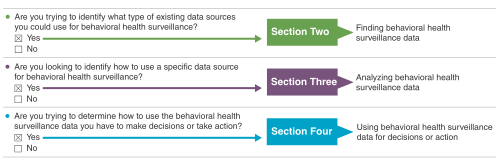
If you are trying to identify what types of existing data sources you could use for BH surveillance, you would focus on Part 2 of the toolkit. If you are looking to identify how to use a specificdata source for BH surveillance, you would focus on Part 3. If you are trying to determine how to use your BH surveillance data to make decisions or take action, you should focus on Part 4.
If you answered no to all these questions, this toolkit may not be relevant to you.
Before Getting Started: Assess Your Needs
Before you get started, it would be helpful to understand the population in your jurisdiction. This effort could consist of conducting or reviewing BH needs assessments (before a PHE occurs), creating or compiling maps or registries of key subpopulations (e.g., those receiving methadone for opioid use disorder) and the BH treatment capacity in your jurisdiction pre-PHE, or conducting or reviewing post-PHE health impact assessments. These steps can provide a more granular picture of where populations of interest may be located and where they can seek BH care if needed (e.g., substance use disorder treatment facilities or inpatient beds dedicated to mental health). CDC also provides guidance on how to conduct health needs assessment (CDC, 2018). Several indexes (e.g., Healthy Places Index, Area Deprivation Index, Social Vulnerability Index), which are typically based on data from the U.S. Census, are available to help you think about your jurisdiction’s unique vulnerability to PHEs.
Summary 1.2 lists additional tips and resources to help you identify unique considerations for the population in your jurisdiction. Understanding the preexisting social conditions that influence vulnerability and create inequities in BH needs and treatment access can help you select and explain the need for PH action (Mays et al., 2022).
Summary 1.2 Tips for Behavioral Health Needs Assessments
What do you need to know about the BH of your population?
- Who is at risk prior to a PHE (e.g., living in unsafe places, prior trauma or such BH issues as substance use disorders)
- Where there are existing resources or assets to support BH
- Who is at risk post-PHE (e.g., homes damaged, family members injured or missing, pre-PHE BH needs were not addressed)
Where can you find information on BH needs of your population or how to assess those needs?
- In ongoing community health needs assessments conducted by PH and BH agencies and health systems in your jurisdiction
- In SAMHSA’s Needs Assessment toolkit (2022c)
- In CDC’s Community Assessment for Public Health Emergency Response (CASPER) toolkit (2020)
Although BH treatment capacity is not the focus of this toolkit, an important part of preparing for potential impacts of various PHEs in your jurisdiction is understanding the unmet need for BH care in the context of a PHE. Think of unmet needs as the mismatch between supply (BH providers, treatment facilities) and demand (burden of BH conditions in the population). Here is an example of doing just that from the New York State Office of Addiction Services and Supports (2022). Your state’s BH agency will likely have conducted a needs assessment (SAMHSA, 2022b) that will be useful for you to review.
Methods to Develop the Toolkit
Methods to develop the toolkit include: (1) a review of the literature and an environmental scan to identify BH indicators, data sources, and analytic approaches that could be used for BH surveillance in the context of PHEs; and (2) exploratory analyses and interviews with public health officials to examine the utility of these data sources for BH surveillance in PHEs.
 Learn more about how the toolkit was developed.
Up Next:
2: Finding Existing Data for Behavioral Health Surveillance
To help you identify the types of BH indicators you could monitor and the data sources that contain those indicators.
Continue