
- actions
- In the context of these workshops, the results of narrative change, such as cultural shifts, policy changes, and program changes
- catalytic measures
-
Measures that do one or more of the following actions:
- help set goals (near-term and adaptable versus long-term)
- frame issues (e.g., health and well-being are about more than health care)
- create common terms to help individuals and organizations see a commonality of interests
- shift venues (e.g. change how and where an issue is framed and discussed)
These measures often can be used as sentinel indicators of community health and well-being to map to the community health narrative North Star.
- culture
- Sharing and alignment of beliefs, attitudes, values, and actions across a set of individuals, organizations, and decision environments (e.g., where policies or laws are made)
- data
- Any facts, statistics, or inputs used for analysis that come from multiple sources, including administrative files and records, encounters, interviews, focus groups, social interactions, or social media
- experiences
- Events or encounters related to lived or personal experiences and/or current events or experiences in a community
- indicator
- A specified percentage, number, or amount of something to be measured (e.g., number of people with cancer, percentage of a budget that goes to parks)
- influencers
- Individuals, organizations, or collective leadership that lead or provoke health conversations, shape stories about health, and/or set the priorities for health in a population or community
- investments
- The allocation of community resources, which include financial resources, community policies, and time dedicated by community leaders
- equity
-
Includes
- procedural equity: the perceived fairness of processes and procedures in decisionmaking
- contextual equity: how preexisting social conditions influence equity
- distributive equity: how social welfare and need is balanced
In some community contexts, the word equity might not be useful or desirable. Here are some options for terms that could help keep the conversation going:
- health opportunities
- social contexts around health
- fairness in health
- health for all
- health choices
- frames
- Underlying values and beliefs about what influences outcomes (e.g., health outcomes)
- health equity
- The fair and just access to the opportunity to be healthy for all
- measure
- A way of categorizing something to assess, track, or understand it (e.g., positive mental health, health care investments)
- messages
- The articulation of the narrative frame that serves as the strategic foundation for storytelling
- mindsets
- Ways that individuals and groups think about a topic, such as health and well-being
- narrative
-
The critical frames and resulting stories and messaging that influence and inform the way people and communities see and describe the world
A narrative helps to articulate a way of understanding the world and informs how people then act.
- performance-based measures
-
Measures that are focused on accountability and linked to rewards and punishments
These measures tend to be most useful to track a department’s or organization’s effectiveness.
- stories
-
Accounts of experiences via oral or written tradition
Narratives can represent the aggregation of stories that we see, hear, and experience.
- values
- Individual and community principles or standards of behavior
- well-being
-
The full range of assets and capabilities that people need to thrive and create meaningful futures
Well-being is multifaceted and includes
- individual well-being: the state in which people experience happiness and satisfaction and can realize their full potential
- community well-being: the combination of social, economic, environmental, cultural, and political conditions identified by individuals, families, and their communities as essential for them to flourish and fulfill their potential
- collective well-being: the expression of the connections between individual and community well-being. When communities (e.g., places or cultures) are characterized by a strong collective well-being, they have the collective will and connected experiences that allow community members to work together to address systemic harms and build a future together. For instance, collective well-being can refer to the strength and quality of connections among people, between people and institutions in the community, and between people and nature.
Throughout each module, we include these key features with corresponding icons to enhance your understanding and to guide action.
Module 2 Walking the Talk
Advancing a Community Narrative That Supports Health and Well-Being, Particularly Health Equity and Collective Well-Being

What Is in This Module?
This module focuses on health and well-being narratives in your community and the underlying frames (values or beliefs) guiding those narratives. Narratives include these frames and the resulting stories and messaging that influence and inform the way people and communities see the world.
In this module, you will work to guide your community to build a narrative with a strong focus on health equity and well-being and a particular emphasis on collective well-being. As described later in this module, narratives are key to motivating a community to consistently act on behalf of health and well-being.
We recommend that you complete this module before working on other modules (particularly Module 3, Measuring for Action, and Module 4, Connecting Intention to Action).
As a reminder, the definitions of terms such as health equity and collective well-being are in the glossary. These two terms serve as the pillars of each toolkit module.
Use this module to invite leaders in your community into conversations about health and well-being narratives. See the introduction if you are unsure about which leaders to include. As with other modules in this toolkit, this module includes new concepts, discussion prompts, and group exercises. It can be facilitated by a group leader or worked on collaboratively in a group setting.
Facilitator Instructions
- A computer or mobile device (if using the digital toolkit)
- A whiteboard or large easel pad in a central location for group exercises
- Easel pads for each small group
- Markers (enough for each small group)
- Printouts of the resources provided at the end of the toolkit (e.g., Participant Workbook, glossary) to provide as handouts; printouts of module pages for those who do not have a computer or mobile device
- Optional sticky notes or notepads for individual brainstorming
- Pens, markers, and paper for notetaking, if preferred
Skills Acquired to Walk the Talk
By the end of this module, Walking the Talk, your community will be able to
- explain what narrative is and why it matters for advancing health and well-being in your community
- describe some of the values and beliefs that underlie your community’s views and actions related to health and well-being
- identify ways that your community’s health narrative can sharpen a focus on health equity and collective well-being specifically.
Organization of This Module
This module is organized into several sections that build on one another:
Appendix B in the annex to this toolkit outlines the guiding principles that inform the design of this module.
Section A Explaining Narrative
Key Terms

Figure Details
An infographic titled "Narratives and the Power They Hold to Change the World" explains the concept and impact of narratives. Text at the top reads "For those seeking to advance a more just, healthy, and sustainable world, narrative can be one of the most powerful tools. The narratives we accept—and the narratives we reject—reveal something about ourselves, the world we see, and the change we seek to create or the status quo we strive to protect. No narrative exists in a vacuum. It is deeply influenced by—and in turn can influence changes in—the social, cultural, environmental, and political ecosystems all around us. Similarly, while the mindsets people hold shape their receptivity or resistance to narratives, narratives can also influence changes in people’s mindsets.
- At the center is a tree representing a narrative, which is defined as "The articulation of a particular way of understanding the world and how it works that shapes what people think, believe, and do."
- The tree has three key components:
- Stories (leaves): Located at the top of the tree, stories are explained as "What people experience over time both literally (e.g., through social media, oral tradition, etc.) and figuratively (e.g., through policy, the built environment, etc.) that aggregates to create or reinforce a particular narrative."
- Messaging (the trunk): Defined as "The core ideas that provide the foundational structure for the narrative."
- Values (the roots): Explained as "The deeply held beliefs that ground the narrative; connect it to what people care about; and increase their likelihood of attention, adoption, and action."
- Supporting elements include:
- Ecosystem (globe icon, middle-left): Described as "The contexts in which people are exposed to narrative, including their environment, lived experience, and the echo chambers through which they receive information."
- Mindsets (red silhouette of a human head, middle-right): Defined as "The collection of perspectives and attitudes that shapes people’s receptivity or resistance to narratives and to changes in behavior, social norms, or policies/systems."
The diagram visually connects the narrative tree to ecosystem and mindsets, emphasizing the interdependence of these factors in shaping perceptions and driving change.
Going deeper, frames (or the roots of a narrative) are used by a variety of influential people (individuals, organizations) and can result in actions in a community, such as shifting the culture around an issue, a programmatic change, or a policy change (Figure 2.2).

Figure Details
A diagram illustrating the interconnection between three elements: Frames, Influencers, and Actions, under the overarching concept of "Elements of Narrative."
- At the top, a box labeled "Elements of Narrative" leads to a box labeled "Frames." Two arrows descend from "Frames," connecting to two boxes below.
- On the left, a box labeled "Influencers" lists examples: Individuals, Organizations, and Collective Leadership.
- On the right, a box labeled "Actions" lists examples: Cultural Shifts, Programmatic Change, and Policy Change. The boxes are all connected by horizontal double-sided arrows, indicating bidirectional interactions between Frames, Influencers, and Actions.
Key Terms
Narratives can be very influential, and they are important to both analyze and develop for the following reasons:
Using the discussion prompts for this section, you will work through some exercises to try to get a feel for the narratives that exist in your community. In later exercises, you will explore elements of narrative frames that could help you generate a more productive health narrative to guide your efforts.
Facilitator Instructions
Spend two to three minutes answering the questions individually using notepads, sticky notes, or the provided Participant Workbook. Have participants post their answers on a large poster board or in a central location.
Share perspectives from around the room for five to ten minutes (depending on group size), ensuring that different voices and sectors are heard.
Here are some additional questions you can pose to the group during discussion:
- In what ways are these existing narratives supportive of our efforts to improve health and well-being? What about health equity?
- In what ways might they be holding us back? (Think about how narratives affect our ability to connect different sectors to the task of improving health or connect efforts that are specific to different topics or health issues.)
Talking Points
During discussions about health, community members might struggle with the toolkit’s significant focus on narrative. If this concern arises in your group discussions, here is one way to make the case for the importance of narrative:
Studies have shown that American mindsets and expectations about health really matter.
Studies by RAND, the Robert Wood Johnson Foundation, and other organizations indicate that the American public’s views on health can affect their communities’ ability to achieve their health goals (Chandra et al., 2024). For instance, many Americans equate health with health care and fail to recognize the influence of social and environmental factors on health outcomes. Additionally, many Americans remain dissatisfied with health outcomes and doubt their community’s ability to work together to improve health. These points are just a sampling that highlight the importance of starting community health efforts with an understanding of health values, beliefs, and experiences.
Section B Unpacking Frames
In this section, we will dive deeper into the concept of frames—the root values and beliefs in a community.
Key Terms
Frames are the underlying values and beliefs that influence something, such as a health outcome.
Many factors can influence frames, such as the
- history of a community
- experiences in a community
- community’s culture
- mindsets
(i.e., the beliefs, attitudes, and assumptions of a person or group) of community members or the community overall.

Figure Details
- A diagram titled "Elements of Narrative" is divided into two sections.
- On the left side, a list labeled "Some factors that influence frames" includes: mindsets, values, experiences, culture, and history. These factors point to a horizontal box labeled "Frames."
- On the right side, a tree illustration visualizes the narrative structure. The tree's leaves are labeled "Stories," the trunk is labeled "Messaging," and the roots are labeled "Frame," signifying that frames form the foundation of narratives. There is a circle around “Frame” to indicate that this graphic is focused on the Frames element of narrative.
Facilitator Instructions
As a group, consider the question:
- What are our community’s values?
Some examples could include “justice for all” or “neighbors helping neighbors.” Write down the community values that your group comes up with on a large easel pad or in another central location. These values should not necessarily be related to health and well-being but should reflect the broader culture and ethos of your community. Continue the exercise for ten minutes, depending on group size.
Key Terms
Now you will dive specifically into frames that relate to health and well-being. The following frames were identified in Sentinel Communities:
Not all frames were present in all communities, and not all communities had only one frame. But communities often had a dominant frame that informed their health actions.
To advance health equity and collective well-being—the two pillars of this toolkit—we highlight frames that focus on social and environmental drivers of health (e.g., healthy people need healthy environments) as important and helpful.
Facilitator Instructions
We advise forming small groups of no more than six people. To ensure robust discussion, groups should reflect different perspectives and community sectors. Ask groups to discuss these questions for ten to fifteen minutes. Then, reconvene to have them share their answers.
Here are some additional questions you can pose to the group during discussion:
- In this discussion, what stuck out for you in the points raised by your peers?
- Are there common themes or connections among these ideas?
The information discussed during this exercise can be documented in the Participant Workbook.
Section C Shaping Stories About Health Equity
In this section, you will apply the community frames that you identified in the prior sections to the stories about health equity and collective well-being that circulate in your community. The objective of this section is to consider how the current frames in your community (informed by values, history, and so forth) can be used to advance dialogue and action on health equity and collective well-being.
Talking Points
As also noted in Module 1, different communities approach the issue of health equity in different ways. Sometimes the word equity might not be useful or desirable. Fortunately, there are other ways to approach this concept. What is important is not the specific term but finding ways to help different people, groups, and neighborhoods lead healthier lives.
Here are some options for terms that could help keep the conversation going. Think about which term or terms might work best for your community:
- health opportunities
- social contexts around health
- fairness in health
- health for all
- health choices
Facilitator Instructions
Spend two to three minutes answering the questions individually using notepads, sticky notes, or the Participant Workbook. Have participants post their answers on a large poster board or in a central location.
Share perspectives from around the room for five to ten minutes (depending on group size), ensuring that different voices and sectors are heard.
Here are some additional questions you can pose to the group during discussion:
- Looking at the reasons that people gave for why some people are unhealthy in this community, what feels most relevant?
- What were the frames guiding those ideas? How do those ideas relate to our community’s values, experience and history, and culture?
Talking Points
It is important to recognize what people generally understand or feel about health equity, as this information can affect how you might view your own community’s attitudes. Read on for more information about national perspectives on health equity and how communities are approaching this issue. Familiarizing yourself and your community with such data can inform whether your community prioritizes a health equity issue and the narrative the community might advance for health and well-being.
Talking Points
The Sentinel Communities project shows that communities are approaching health equity and related topics differently. Some focus on closing gaps between groups (e.g., thinking about how to resolve disparities in health outcomes between groups). Others focus on creating positive ripple effects (i.e., “lifting all boats”) through initiatives that are geared toward economic or educational opportunity and that have the goal of positively influencing health. Other communities are focused on the structures and systems that might have created the conditions for existing health inequities. Understanding where your community stands in relation to these three categories will help you determine the dominant health narratives in your community and how you might address the underlying frames of those narratives.
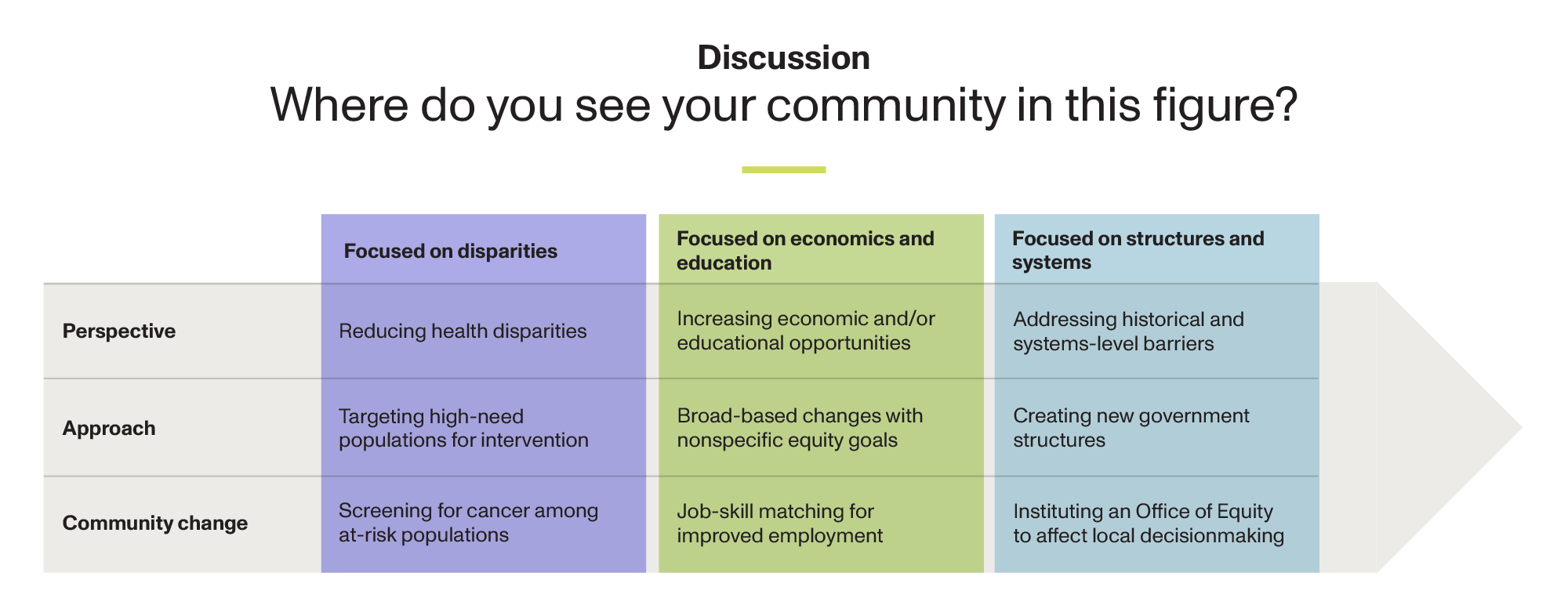
Figure Details
A figure that consists of three overlapping horizontal arrows transitioning from left to right. The arrows illustrate a progression of community focus on health equity and text describes areas of community change, approach, and perspective that relate to each approach to equity.
| Approach to Equity | Focused on disparities | Focused on economics and education | Focused on structures and systems |
|---|---|---|---|
| Community change | Screening for cancer among at-risk populations | Job-skill matching for improved employment | Instituting an Office of Equity to affect local decisionmaking |
| Approach | Targeting high-need populations for intervention | Broad-based changes with nonspecific equity goals | Creating new government structures |
| Perspective | Reducing health disparities | Increasing economic and/or educational opportunities | Addressing historical and systems-level barriers |
A box includes the text: “Discussion: Where do you see your community in this figure?”
As you look at the figure, consider the following question as a group:
- Where does your community fit in the three categories in this figure?
- Are you a community that is focused on disparities, a community that is taking a broad approach to economic and/or educational opportunity with the aim of influencing health, or a community that is focused on making systemic changes to address health inequities?
Facilitator Instructions
Create groups of no more than six people. Take 20 minutes for groups to develop a story and a set of messages to deliver to the sector with which they are communicating (or convincing). The goal here is to shift a frame on why health equity matters for that sector. There are fields in the Participant Workbook to write these stories and messages down, but each group should also use easel pads and markers to document their work.
When the groups come back together, the group leader or facilitator can prompt questions, such as the following:
- Why did you choose those messages? What were you trying to appeal to in your specific sector’s health frames?
- Do you think the set of messages and the story that your group created will compel that sector to engage in the community actions for health equity? Why or why not?
An Example Start to Changing the Frame on Health Equity
An employer is trying to figure out why issues of health equity might matter to the Company’s board and why the Company should consider investing in community health as part of its corporate social responsibility. The leadership in the city where the Company is based is trying to get all organizations to help advance the city’s health equity strategy. In a conversation between the chief executive officer (CEO) of the Company and the mayor, the following points are made:
- The CEO says, “We already fund health insurance and the employee wellness program. Isn’t that enough? We don’t have a broader role in health equity because that issue doesn’t affect our bottom line.”
- The mayor responds, “That isn’t quite true, Ms. CEO. A lack of health equity has ripple effects across the economy. Some estimates indicate that health inequities cost the U.S. economy $450 billion a year. When an issue has that type of effect on the economy, all sectors, including the business sector, have a role to play in addressing it. Plus, communities are filled with consumers, and healthy community members make active consumers.”
Section D Shaping Stories About Collective Well-Being
In this section, you will try to apply the community frames that you identified in the prior sections to stories about shaping collective well-being for your community. The objective of this section is to consider how the current frames in the community (informed by values, history, and so forth) can be used to advance dialogue and action on collective well-being.
- Well-being
- The full range of assets and capabilities that people need to thrive and create meaningful futures
- Individual well-being
- The state in which people experience happiness and satisfaction and can realize their full potential
- Community well-being
- The combination of social, economic, environmental, cultural, and political conditions identified by individuals, families, and their communities as essential for them to flourish and fulfill their potential
- Collective well-being
-
The expression of the connections between individual and community well-being
When communities (e.g., places or cultures) are characterized by a strong collective well-being, they have the collective will and connected experiences that will allow community members to work together to address systemic harms and build a future together. For instance, collective well-being can refer to the strength and quality of connections among people, between people and institutions in the community, and between people and nature.
Talking Points
Sometimes, a term such as well-being can be challenging. For some, it can incorrectly mean wellness and is linked with mindfulness or exercise programs (e.g., meditation, yoga). For others, it can seem like an out-of-reach, aspirational state. If your community does not respond to the term well-being, that is okay as long as you keep in mind the two most important aspects of well-being as a concept.
- A comprehensive view of health: Ensure that health actions in your community consider the multiple and holistic dimensions of health (e.g., social, emotional, physical, cultural, spiritual).
- A positive redefinition of health: Focus on health not just as the absence of disease but as actions and choices that build positive assets to reach individual and community potential (you can think about it as thriving and not just surviving).
Although they are not the same as well-being, here are some other terms that could be used:
- positive health
- hope
- thriving and flourishing
- quality of life
Given this toolkit’s focus on different types of well-being in general and its emphasis on collective well-being in particular, such phrases as improving connections could also work.
Key Terms
Check out Module 1 for more information about why well-being matters. What key points should communities address to advance action? Consider the following points:
- emphasizing the importance of positive health (not just the absence of disease)
- finding ways to discuss progress (e.g., including well-being indicators and not just economic ones)
- avoiding a focus on one siloed health condition after another or the creation of short term fixes that fail to connect the dots—for example, the COVID-19 response failed to connect the dots between physical health and emotional well-being
- promoting well-being by investing in its various dimensions (e.g., social, cultural, structural).
Here are some examples to illustrate what differentiates a community that centers well-being:
- A community with an economy based on well-being would focus not just on providing jobs but also on meaningful work (Wellbeing Economy, undated).
- A community focused on well-being would not just deliver individual mental health interventions but also work on the connections between people to support social connection.
Facilitator Instructions
Spend two to three minutes answering the questions individually using notepads, sticky notes, or the Participant Workbook. Have participants post their answers on a large poster board or in a central location.
Share perspectives from around the room for five to ten minutes (depending on group size), ensuring that different voices and sectors are heard.
Here are some additional questions you can pose to the group during discussion:
- Looking at the messages that people gave about how people in this community talk about well-being, what feels most resonant?
- What were the frames guiding the ideas in those messages? How do those ideas relate to our community’s values, experiences and history, and culture?
Facilitator Instructions
We advise forming small groups of no more than six people. To ensure robust discussion, groups should reflect different perspectives and community sectors.
Groups should take 20 minutes to develop their story and set of messages for the health topic assigned. There are fields in the Participant Workbook to write these stories and messages down, but each group should also use an easel pad and markers to document their work.
Here are some additional questions you can pose to the group during discussion:
- Why did you choose those messages? What were you trying to appeal to in your specific sector’s health frames?
- Do you think you can tell a broader story of collective well-being as you work on health issues in your community? Why or why not?
An Example Story on Collective Well-Being
A spike in suicides among youth in Everytown has community leaders worried. Everyone is scrambling for the right solution to the issue. Does it involve providing more mental health services in schools or banning social media? Should the focus be on getting more young people into after-school programs?
A meeting of community leaders—both adults and youth—is convened to address the issue. Vocal advocates in the community argue for their version of the right solution.
Their arguments are as follows:
- The youth say, “We have to step back here and look at what has been driving this issue. How are the concerns for youth in our community connected? If we focus on dealing only with suicides, then we are already too late. Youth are dealing with other issues such as anxiety and depression, loneliness, and a lack of hope for the future.”
- The community leaders look to the recent past and question what has
been happening in the community over the past few years. They ask the
following questions:
- Have neighborhoods become detached from each other?
- Are groups connected?
- Do we even know how youth are feeling about their lives? We have a lot of data on suicide now, but what about the factors that affect a child before they become suicidal, such as anxiety, depression, loneliness, and bullying?
- What investments are being made to help youth socially, emotionally, spiritually, and otherwise?
- In addition to each individual young person, does the community feel well?
- The leaders realize that they have been dealing with these issues in ways that are fragmented. If they take an approach that looks at community connections and everyone’s collective roles, they can build a community that supports the health and emotional well-being of all youth in their community.
Section E Identifying Narrative Influencers in the Community
Key Terms
Influencers are key to crafting, driving, and sustaining narratives. Actions are the results of narrative change and can, in turn, influence frames that undergird narratives. Thus, making cultural shifts or changing programs or policy can start to shift or move a community’s health narrative because the influencers shift the frames that underlie the narratives. However, the impact can go the other way as well. For instance, an action (e.g., policy) that a community takes can shift the underlying frames about how the community views an issue. Influencers can take frames forward into action but also can change the frames themselves.
Figure Details
A diagram illustrating the interconnection between three elements: Frames, Influencers, and Actions, under the overarching concept of "Elements of Narrative."
- At the top, a box labeled "Elements of Narrative" leads to a box labeled "Frames." Two arrows descend from "Frames," connecting to two boxes below.
- On the left, a box labeled "Influencers" lists examples: Individuals, Organizations, and Collective Leadership.
- On the right, a box labeled "Actions" lists examples: Cultural Shifts, Programmatic Change, and Policy Change. The boxes are all connected by horizontal double-sided arrows, indicating bidirectional interactions between Frames, Influencers, and Actions.
Facilitator Instructions
Spend two to three minutes answering the questions individually using notepads, sticky notes, or the Participant Workbook.
Share perspectives in small groups for 15 minutes. During discussion, write down responses to the first set of questions in one column on an easel pad or in a central location. Write responses to the second set of questions in another column.
Section F Taking Steps Forward on the Health and Well-Being Narrative
It will take some time to digest the concepts and ideas in this module. Developing a coherent, actionable narrative that can serve as your community’s North Star on health and well-being does not happen overnight. This module is intended to help your community take its first steps toward creating a narrative that actively advances health equity and collective well-being. But this work will require a deep consideration of your community’s values and experiences and how those factors tie into perspectives and priorities on health and well-being. These efforts will help to keep moving your narrative forward, maturing it, and then working as a community to advance it.
The next modules begin to unpack other sticking points—data and investment—that are the focus of this toolkit. But know that the issue of narrative will continue to show up in this toolkit. Having a clear narrative is key to knowing which data matter and how to best align investments.
Despite the time it takes to develop a coherent, actionable narrative, your community members can start right now to move their ideas forward. Try out the following discussion prompt before you complete this module. The prompt will take two perspectives, described as the forest and the trees.
First, consider what your group would say in the following scenarios if you were advancing a broader health and well-being narrative using these concepts. Remember the focus on health equity and collective well-being.
Facilitator Instructions
Take ten to fifteen minutes to discuss these questions as a group and capture key points.
Now to the trees: Consider what your group would say if they were trying to link an issue or topic on health (or another area) to the broader narrative about health and well-being. Again, remember the focus on health equity and collective well-being.
Facilitator Instructions
Take ten to fifteen minutes to discuss these questions as a group and capture key points.
Section G Ready to Move to the Next Module?
By the end of this second module, you should have discussed the following:
- what narrative is and why it matters for advancing health and well-being in your community (Section A)
- the values and beliefs that underlie your community’s views and actions for health and well-being (Section B)
- the ways that your community’s health narrative can sharpen a focus on health equity and collective well-being specifically (Sections C–F).
If you have a good understanding of these issues in your community, you are ready to move to the next module—Module 3, Measuring for Action. If not, you can revisit the sections of this module and the corresponding exercises to deepen your insight.
Reminder
After completing this module, document your key takeaways and action items. There is a place to do this in the Participant Workbook.

For feedback on this toolkit and to share how you are using it in your community, please send an email to: