Improving the Quality of Mental Health Care for Veterans
Lessons from RAND Research
Research SummaryPublished Aug 13, 2019
Lessons from RAND Research
Research SummaryPublished Aug 13, 2019

Veterans, especially those who deployed overseas, face elevated risks of mental health conditions. Veterans who have served since the September 11, 2001, attacks are especially vulnerable (see Figure 1). Roughly one in five veterans experiences mental health problems, including posttraumatic stress disorder (PTSD), major depression, and anxiety. Deployment can also increase the risk of unhealthy alcohol and drug use, substance use disorders, and suicidal behavior. If left untreated, these conditions can have long-lasting and damaging consequences, impairing relationships, work productivity, quality of life, and overall well-being for veterans and their families.

| Experience PTSD | Experience depression | Have traumatic brain injury | Have alcohol dependence | Have difficulty with civilian life | Experience strains in family life | Feel sudden outbursts of anger |
|---|---|---|---|---|---|---|
| 13–20% | 10–15% | 19–23% | 15–44% | 44% | 48% | 47% |
SOURCE: Tanielian, Batka, and Meredith, 2017.
RAND Corporation researchers have conducted multiple studies of the quality of mental health care received by veterans across the systems that deliver this care. This brief summarizes the main lessons from this work and shares recommendations for policies and further research.
To better serve the mental health needs of veterans, RAND research leads to six primary recommendations:

Photo by noipornpan/Getty Images
High quality in health care was defined by the Institute of Medicine in its 2001 report Crossing the Quality Chasm: A New Health System for the 21st Century as care that is safe, patient centered, effective, equitable, timely, and efficient. Much research has focused on understanding the availability and use of treatment that is effective. Effective treatments are those that have been shown to work, based on scientific research and clinical experience. Evidence-based practice (EBP) refers to specific forms of care that meet these criteria (see Figure 2). EBPs have been peer reviewed by scientists and clinicians, and there is empirical evidence for their effectiveness. In some cases, EBPs have been proven to produce significant reductions in symptoms in controlled experimental research studies, which represent the gold standard of scientific evidence for medical treatments. Clinical practice guidelines are systematically developed statements based on scientific evidence that help providers and patients make decisions about appropriate health care practices for specific clinical circumstances, according to the Institute of Medicine's 2011 report Clinical Practice Guidelines We Can Trust. Guidelines are based on reviews of the scientific literature and expert consensus. Treatment recommendations are assigned a grade of A, B, C, or D based on the strength of the scientific evidence, with a grade of A being the equivalent of "strongly recommended."
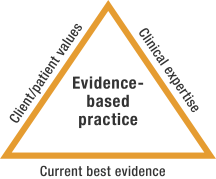
The three components of evidence-based practice are
SOURCE: Carol B. Peterson, Carolyn Black Becker, Janet Treasure, Roz Shafran, and Rachel Bryant-Waugh, "The Three-Legged Stool of Evidence-Based Practice in Eating Disorder Treatment: Research, Clinical, and Patient Perspectives," BMC Medicine, Vol. 14, No. 69, April 14, 2016.
It is important that veterans who experience mental health conditions and substance use problems receive treatment and get the best quality care available. Evidence-based treatment improves recovery rates. It also reduces the likelihood of other negative consequences that can follow from mental health and substance use conditions, such as health deterioration and problems in relationships and work. Poor-quality care, by contrast, is less likely to lead to recovery. Furthermore, poor experiences with care can discourage veterans from seeking further care. There are also substantial monetary costs associated with substandard and inaccessible mental health care. In 2008, RAND researchers estimated the two-year societal costs of post-deployment mental health problems, such as PTSD and depression, among veterans who had served since the September 11, 2001, attacks to be approximately $6.2 billion (in 2007 dollars) (Tanielian and Jaycox, 2008). The study estimated that if all veterans received high-quality care for these conditions, these costs could be reduced by $1.2 billion (in 2007 dollars). Thus, high-quality care can stem adverse consequences for veterans and families and also reduce the economic burden on society. See the next page for examples of some EBPs.
High-quality care can stem adverse consequences for veterans and families and also reduce the economic burden on society.
Two medical systems are primarily responsible for meeting veterans' mental health care needs: the VA health care system and nonmilitary, private-sector health care providers. In recent years, these systems have reacted to the growing recognition of the need to expand access and improve the quality of mental health care for veterans by hiring more providers, conducting increased trainings, expanding the use of telemental health services, and creating new programs in the community.
More than 9 million veterans are enrolled to receive care from the VA health care system (see sidebar). To serve this population, VA operates the nation's largest health care system providing both inpatient and outpatient services, with 172 VA medical centers and 1,069 outpatient clinics across the country. In 2018, VA delivered mental health care to an estimated 1.7 million veterans.[1] Compared with nonveterans, veterans are disproportionately older, male, and less healthy. Veterans who use VA health care — VA patients — are typically older than other veterans. Fifty-two percent of veterans who use VA health care are over age 65, while only 39 percent of veterans who are not VA patients are over age 65. VA patients are also more likely than other veterans to have been deployed. Partly as a result of their older age and deployment experience, VA patients have higher rates of mental health conditions and chronic physical conditions than other veterans.
RAND researchers have conducted major studies of VA's capacity for delivering high-quality mental health care, including a comprehensive evaluation of the VA mental health system (Watkins et al., 2011); a congressionally mandated analysis of the quality of VA health care compared with that delivered by other health systems as part of a broader assessment of VA's health care resources and capabilities (Hussey et al., 2015); and an analysis of the purchased care system, in which veterans receive care paid by VA but delivered by private providers (Farmer and Tanielian, 2019).
Several themes recur across this work:
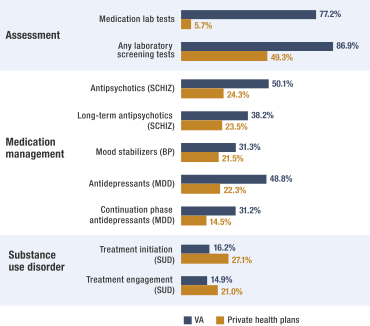
| VA | Private health plans | ||
|---|---|---|---|
| Assessment | Medication lab tests | 77.2% | 5.7% |
| Any laboratory screening tests | 86.9% | 49.3% | |
| Medication management | Antipsychotics (SCHIZ) | 50.1% | 24.3% |
| Long-term antipsychotics (SCHIZ) | 38.2% | 23.5% | |
| Mood stabilizers (BP)) | 31.3% | 21.5% | |
| Antidepressants (MDD) | 48.8% | 22.3% | |
| Continuation phase antidepressants (MDD) | 31.2% | 14.5% | |
| Substance use disorder | Treatment initiation (SUD) | 16.2% | 27.1% |
| Treatment engagement (SUD) | 14.9% | 21.0% | |
SOURCE: Watkins et al., 2011.
NOTES: Figure shows the national average percentage of the VA cohort and the private plan cohort meeting performance indicators, compared with the national average of private providers, based on 2007 data. BP = bipolar 1 disorder; SCHIZ = schizophrenia; MDD = major depressive disorder; SUD = substance use disorder.
Veterans receive a substantial amount of their care from providers in private or community settings, referred to hereafter as "private providers." Seventy percent of prescriptions, 70 percent of inpatient visits, and 85 percent of office visits for veterans occur outside VA. Even veterans enrolled in VA health care receive only 30 percent of their care on average from VA (Farmer, Hosek, and Adamson, 2016).
Information on the quality of mental health care delivered to veterans in private settings remains sparse. Using criteria developed from the requirements and expectations for VA providers, recent RAND research has shed some light on the quality of care delivered by private providers and found a mixed picture. For example:
Overall, the surveys showed that private providers were less prepared than VA providers to deliver high-quality mental health care to veterans.
Recently, VA has taken steps to help private providers serve veterans more effectively. For example, VA has created toolkits and other resources, including training programs. In addition, many nongovernmental programs have been created to raise awareness and offer training to improve the ability of private providers to deliver high-quality mental health care to veterans. However, little is known about the quality of training programs, particularly with respect to how they improve provider competency and fidelity in delivering evidence-based psychotherapy. To shed light on this issue, RAND researchers developed the Training in Psychotherapy (TIP) tool (Hepner et al., 2018). TIP enables stakeholders to assess how a psychotherapy training incorporates evidence- and expert-derived core components, indicating the degree to which the training can support clinicians to competently deliver evidence-based psychotherapy to veterans.
When veterans are unable to access or receive high-quality care, the reasons are strikingly similar across both VA and private care settings.
Organizational and provider-related barriers are prominent, including
Patients report beliefs that can reduce the likelihood of seeking mental health care, including
In the context of the current landscape for veterans' mental health care, six broad recommendations emerge from RAND research.
The United States needs to expand efforts to strengthen the capacity of mental health providers to deliver evidence-based treatments, both within VA and among private providers. VA should continue its investment in disseminating and requiring delivery of evidence-based treatments. Private-sector mental health providers need to be better equipped to work with the veteran population, and, thus, there is a need to improve community provider training for treating veterans.
Efforts to promote help-seeking among veterans are necessary. Given the concerns that veterans have expressed about the effectiveness of mental health treatment, resources to help them understand what effective mental health care entails and where to find it are necessary. Veterans should be informed consumers when choosing mental health providers and work with their therapists to address any specific concerns to ensure that they are getting the best care possible. At the same time, VA and other providers should explore new delivery approaches that can help to expand access, including training additional providers in delivering evidence-based mental health treatment and telemental health care options.
Policymakers can help motivate the use of evidence-based, high-quality treatment by setting and enforcing consistent standards across all payers for delivery of mental health services. One approach would be adjusting financial reimbursement for providers to offer appropriate compensation and incentives to attract and retain highly qualified professionals and ensure motivation for delivering quality care.
Little is known about the timeliness or quality of care that veterans receive through these programs as mandated. In addition, VA needs to undertake a systematic analysis of quality and access in these programs
These approaches should be rigorously evaluated to assess that the interventions produce symptom recovery and ensure safety and longer-term effectiveness.
The use of these treatments has outpaced the underlying science. Rigorous studies of the impact of particular therapies on specific conditions are needed.
This research brief was made possible, in part, by the Zwick Impact Fund. Charles Zwick — a researcher at RAND from 1956 to 1965 who later served as both a trustee and an advisory trustee — presented RAND Ventures with $1 million and the charge to take on new and emerging policy challenges and to support top talent in their focus on these issues. Each year, RAND's president and CEO draws on this generous gift to help RAND research and outreach teams extend the impact of completed research.

This publication is part of the RAND research brief series. Research briefs present policy-oriented summaries of individual published, peer-reviewed documents or of a body of published work.
This document and trademark(s) contained herein are protected by law. This representation of RAND intellectual property is provided for noncommercial use only. Unauthorized posting of this publication online is prohibited; linking directly to this product page is encouraged. Permission is required from RAND to reproduce, or reuse in another form, any of its research documents for commercial purposes. For information on reprint and reuse permissions, please visit www.rand.org/pubs/permissions.
RAND is a nonprofit institution that helps improve policy and decisionmaking through research and analysis. RAND's publications do not necessarily reflect the opinions of its research clients and sponsors.