Summary of Trust Unpacked: A diagnostic assessment of institutional trust

Research SummaryPublished Nov 24, 2026

This research was made possible by the UK Economic and Social Research Council (ESRC) [grant number UKRI4777].

Conceptual and methodological foundation

Trust is the 'willingness of a party to be vulnerable to the actions of another party based on the expectation that the other will perform a particular action important to the trustor, irrespective of the ability to monitor or control that other party' (Mayer et al. 1995). Trustworthiness refers to the qualities of institutions that make them deserving of this trust. There is sustained concern about declining trust in institutions and the implications of this for policy delivery and the legitimacy of public institutions. Our report argues that understanding institutional trust requires moving beyond measuring whether people trust institutions and towards understanding how they evaluate institutional trustworthiness.
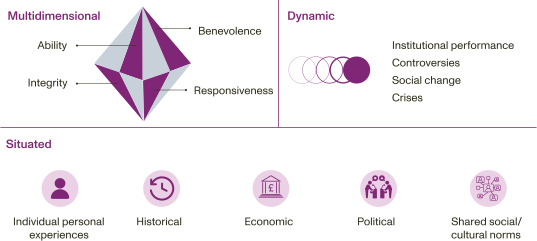
Multidimensional, situated and dynamic trustworthiness

Graphic showing the parts of multidimensional, situated and dynamic trustworthiness

Multidimensional

  • Ability
  • Benevolence
  • Integrity
  • Responsiveness

Situated

  • Individual personal experiences
  • Historical
  • Economic
  • Political
  • Shared social/cultural norms

Dynamic

  • Institutional performance
  • Controversies
  • Social change
  • Crises

Existing assessment methods

Assessment Method Description Concern
Survey-based measures Survey-based measures use consistent metric designs with repeated data collection to directly assess trust/mistrust/distrust. Static snapshots of trust in time, no effective reflection of trust in practice via behaviour/action and difficulty capturing nuance.
Behavioural and experimental approaches Trust games examine action taken by trustors in situations of vulnerability, uncertainty and risk. Behaviour may not be uniquely attributed to trust and a modelled environment at single time-point limits real-world reflection.
Qualitative and ethnographic methods Interview, focus groups, or ethnography examines practical understanding of institutional trustworthiness and decisions to trust in specific contexts. Limited generalisability and replicability and time-/labour-intensive fieldwork with potential researcher and participant bias.
Administrative/operational data analysis Uses administrative and operational data as proxy indicators of trust/trustworthiness to analyse behaviour change, compliance and engagement patterns. Potential selection bias of data, reliance on availability/accessibility of data, concerns of privacy and limited use of this method in literature.
Computational approaches Analysis of online data related to engagement, behaviour and sentiment used for near real-time analysis of response to events. Limited to online user population, relies on indirect rather than stated indicators of trustworthiness and potential interpretation bias.

What is needed?

Problem

There is no single method that captures the multidimensional, situated and dynamic nature of institutional trustworthiness

Focus

Institutional trustworthiness in policing and health data sharing

Aim

Develop and test a diagnostic framework for institutional trustworthiness, to provide a richer understanding of how institutional trust is perceived and how this varies across time and different groups

Goal

Aid institutions to understand areas of emerging concern, identify institutional strengths and weaknesses, and support efforts to strengthen the qualities that make them worthy of public trust

Cover: Summary of Trust Unpacked: A diagnostic assessment of institutional trust

Available for Download

Topics

Document Details

Citation

Chicago Manual of Style

Summary of Trust Unpacked: A diagnostic assessment of institutional trust. Santa Monica, CA: RAND Corporation, 2026. https://www.rand.org/pubs/research_briefs/RBA5389-1.html.
BibTeX RIS

Research conducted by

This publication is part of the RAND research brief series. Research briefs present policy-oriented summaries of individual published, peer-reviewed documents or of a body of published work.

This document and trademark(s) contained herein are protected by law. This representation of RAND intellectual property is provided for noncommercial use only. Unauthorized posting of this publication online is prohibited; linking directly to this product page is encouraged. Permission is required from RAND to reproduce, or reuse in another form, any of its research documents for commercial purposes. For information on reprint and reuse permissions, please visit www.rand.org/pubs/permissions.

RAND is a nonprofit institution that helps improve policy and decisionmaking through research and analysis. RAND's publications do not necessarily reflect the opinions of its research clients and sponsors.