
Ready for 2030 RAND Europe Polling
How the public sees security threats, preparedness, and government's role
To inform the Ready for 2030 conference, RAND Europe commissioned Focaldata to survey the British public on defence, national resilience and preparedness for future security threats. The survey asked how informed people feel about threats, how they rate the UK’s readiness, what they think about defence spending, funding and national service, and who they would listen to. It also tested which messengers and messages are most convincing. The headline findings are highlighted below.
The public acknowledges that the government is not doing enough to prepare the UK – even its own voter base
Do you think the UK Government is currently doing enough to prepare the UK for future security threats?
By 2024 general election vote

Data from polling commissioned by RAND Europe and conducted by Focaldata.
"Grey Zone" threats are seen as most likely to materialise within the next five years
How likely, if at all, do you think each of the following is to happen to the UK within the next five years?
All respondents

Data from polling commissioned by RAND Europe and conducted by Focaldata.
Defence ranks highly as a spending priority, alongside border security and cost-of-living support
Top Spending Priorities
% ranking each option, all respondents

Data from polling commissioned by RAND Europe and conducted by Focaldata.
Yet there is no agreement on how to pay for increased defence spending: voters divide along partisan lines
The UK currently spends around 2.6% of GDP on defence. If the UK were to increase defence spending to the NATo target of 3.5% of GDP by 2035 (up from the current government commitment of 3% by 2027), how do you think this should mainly be funded
% choosing, by 2024 vote

Data from polling commissioned by RAND Europe and conducted by Focaldata.
The public's willingness to stomach a tax increase or to enlist is extremely limited, even in a crisis
Which of the following would you personally be willing to do?
% selecting, by scenario

Data from polling commissioned by RAND Europe and conducted by Focaldata.
And national service only enjoys majority support when it is explicitly framed as voluntary
Would you support or opposite the (re)introduction of each of the following?

Data from polling commissioned by RAND Europe and conducted by Focaldata.
The public is asking for an open conversation, to clarify these trade-offs
To what extent do you agree or disagree with the following statement: "The British public needs a more open and honest conversation about the security threats facing the country."
By 2024 general election vote

Data from polling commissioned by RAND Europe and conducted by Focaldata.
An honest conversation is needed – it should be led by someone in uniform speaking about "growing threats"
Which of these would be the most convincing messenger and message to get the public to take defence and preparedness seriously?
All respondents
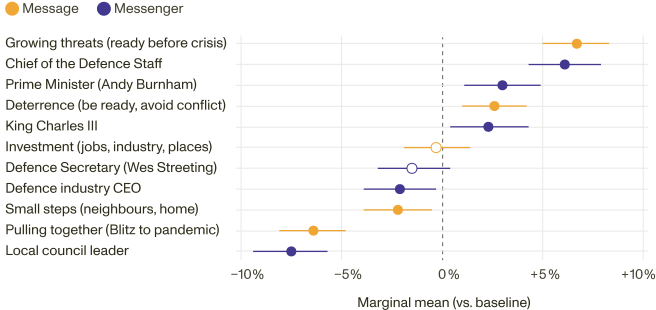
Data from polling commissioned by RAND Europe and conducted by Focaldata.