Towards an Australian Circular Economy for Solar Photovoltaic Technologies
A Policy Brief for Government, Industry and Research Stakeholders
Research SummaryPublished Oct 27, 2026
A Policy Brief for Government, Industry and Research Stakeholders
Research SummaryPublished Oct 27, 2026

Photo by Pixelci/Getty Images
With more than 40.6 gigawatts of installed capacity across more than four million systems, Australia leads the world in per-capita solar photovoltaic (PV) deployment. However, Australia is approaching a structural inflection point in its clean-energy transition.
The infrastructure, regulation and market mechanisms required to manage end-of-life (EoL) solar panels—a consequence of Australia’s clean-energy success—do not yet exist at scale. Panels that were installed during a period of rapid expansion that began in the 2010s are now approaching decommissioning. Estimates indicate that Australia is already generating approximately 40,000 tonnes of EoL PV waste annually, and that could surge to more than 100,000 tonnes per year by the early 2030s. Cumulative PV waste is projected to reach approximately 1.1 million tonnes by 2035—a number that could double or even triple by 2050.
40.6 gigawatts of installed solar capacity—the world’s highest per capita
1.1 million tonnes of cumulative end-of-life waste by 2035, including all historical waste
$1 billion+ of recoverable material value from end-of-life panels by 2035
The timing pressures created by Australia’s solar waste trajectory demand urgent attention. The consequence of the installation spike from 2018 to 2024 is a corresponding decommissioning surge that will arrive regardless of policy settings. The question is whether Australia has the circular infrastructure in place to intercept it. To achieve an affirmative answer, the window between 2025 and 2030 is crucial. This is the only viable period in which Australia can establish a national regulatory framework, fund the necessary infrastructure and build the market mechanisms needed to handle projected volumes of PV waste. To miss this window of opportunity is to allow PV waste volumes to exceed the capacity of any post-2030 ad hoc response.
Critically, the window to plan and implement a comprehensive national approach to tackling PV waste closes before Australia’s next federal election, which is expected in late 2027 or early 2028. Each year of inaction increases the infrastructure deficit, entrenches linear disposal pathways and permanently restricts Australian industry access to recycled critical materials that cannot be retrieved once downcycled or landfilled.
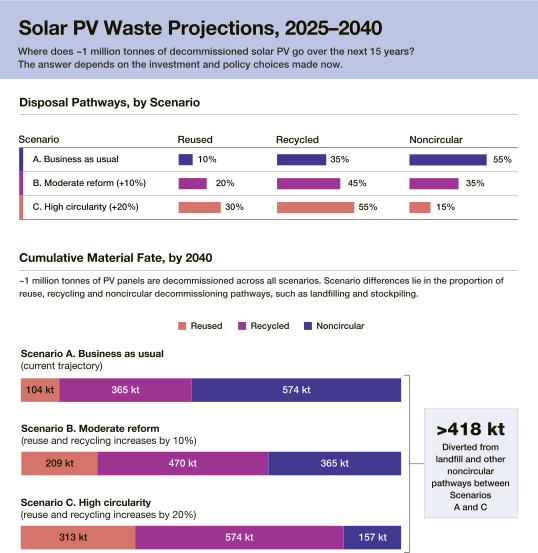
Where does ~1 million tonnes of decommisioned solar PV go over the next 15 years? The answer depends on the investment and policy choices made now.
About 1 million tonnes of PV panels are decommissioned across all scenarios. The scenarios differ in the proportions of reuse, recycling, and noncircular pathways, such as landfilling and stockpiling.
More than 418 kt are diverted from landfill and other noncircular pathways between scenarios A and C.
SOURCES: The cumulative waste data projections are based on the latest industry data from Nick Florin, Hengky Salim, and Benjamin Madden, Managing End-of-Life Photovoltaic Systems in Australia: Key Findings from Installer Survey, Institute for Sustainable Futures, University of Technology Sydney, June 2023; historical installation rates across Australian postcodes from Australian PV Institute, PV Postcode Data, dataset, undated; and Blue Tribe Company, interview with the authors, 2025.
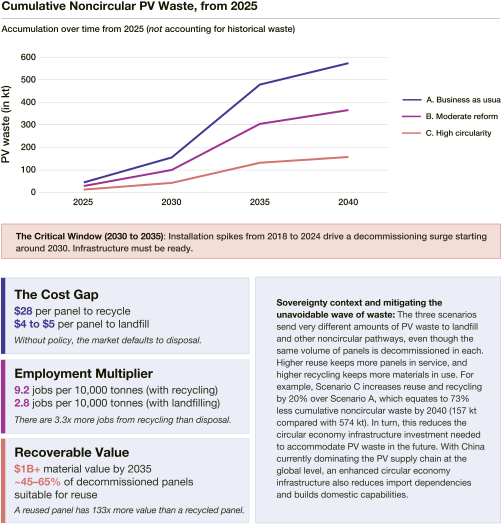
Accumulation over time from 2025 (not accounting for historical waste)
The line chart shows accumulation over time from 2025 and does not account for historical waste. The vertical axis is PV waste in kilotonnes, ranging from 0 to 600. The horizontal axis shows years 2025, 2030, 2035, and 2040.
The Critical Window (2030 to 2035): Installation spikes from 2018 to 2024 drive a decommissioning surge starting around 2030. Infrastructure must be ready.
Sovereignty context and mitigating the unavoidable wave of waste: The text panel explains that the three scenarios accumulate vastly different amounts of PV waste over the coming decades, even though projected waste volumes remain the same across scenarios. This difference is partly due to increased reuse rates, which keep more PV panels in production longer and avoid premature waste pathways. Scenario C, which assumes a 20 percent increase in reuse and recycling, produces a 73 percent drop in cumulative waste volume by 2040. This reduces the circular economy infrastructure investment needed in the future. Because China currently dominates the PV supply chain globally, stronger circular economy infrastructure could also reduce import dependencies and build domestic capabilities.
NOTE: This infographic models only PV panels installed before 2025 and the subsequent waste expected from those panels. It does not include panels installed after 2025 and does not include panel waste accumulated before 2025. Cumulative waste projections (1.0 to 1.2 million tonnes by 2035) include all historical waste. The projections include the following assumptions: (1) the average new panel lifespan (i.e., the number of years until a panel enters decommissioning streams) is 12 years, (2) the average reuse panel operational lifespan is 12 years based on a 25-year design life and average lifespan until decommissioned, and (3) a panel’s weight is 25 kilograms. kt = kilotonne.
Three structural barriers prevent market forces alone from resolving Australia’s PV waste challenge. Each represents a distinct class of market failure that requires targeted policy intervention.
Existing PV recycling facilities are scarce across the country and operate well below the scale needed to handle projected PV waste volumes. Australia’s industrial practices in the PV recycling sector are characterised mainly by chemical-free mechanical recovery methods, including manual dismantling, mechanical processing and separation techniques. These low technology readiness level (TRL) methods significantly limit the recovery of high-value materials, such as silver and pure silicon. Existing industrial capability, measured by TRL and processing capacity, cannot effectively process the incoming PV waste wave. Such methods often downcycle materials by reducing their purity or removing them from circular pathways (by crushing panel components into a powder that is used as an additive in building materials). Testing decommissioned panels for reusability prior to their entering waste or recycling streams is a potentially high-value method for capturing and retaining the panel’s embedded material value. This approach is underutilised without the certification infrastructure needed to scale it.
Industry testing indicates that approximately 45 to 65 per cent of decommissioned panels remain suitable for reuse, refurbishment or continued operation. Yet Australia lacks the collection logistics, workforce skills, testing infrastructure, certification frameworks and domestic remanufacturing capacity to capture this value. The absence of a functioning national marketplace for secondary panels compounds the problem. Logistics costs can constitute up to 60 per cent of total scheme costs, making a geography-optimised collection infrastructure a prerequisite—not an optional enhancement.
Recycling costs approximately $28 per panel; landfill disposal costs between $4 and $5 per panel. Without policy corrections, the market will perpetually default to disposal. This cost gap is worsened by subsidised recycling operations that are, in practice, downcycling, including the mechanical crushing of panels for incorporation as additives in construction materials. This process permanently destroys the silicon, silver and copper embedded in solar panels, and these valuable materials cannot be recovered once they are dispersed in such applications as cementitious matrixes. Subsidising these downcycling practices slows the market-led development of genuine high-value circular infrastructure.

Photo by Thurtell/Getty Images
The research that underlies this brief demonstrates that Australia can build circular PV capabilities through coordinated action across five activity areas. These pathways are not sequential and should proceed in parallel. The policy and market pathways provide the enabling conditions for the technical and logistical pathways to scale. The Three Horizons timeline (presented in Table 1) is drawn from a detailed implementation roadmap in the main report. The timeline maps each pathway across three planning horizons aligned with Australia’s Net Zero 2050 plan.
The economic case for prioritising reuse above recycling is unambiguous. Recovery technology that has been available since 2023 demonstrates that the economic value of a reused PV panel is 133 times greater than that of a recycled panel, primarily because reuse captures the remaining power generation value of a functional asset rather than only its raw material content. Given that 45 to 65 per cent of decommissioned panels remain suitable for continued use, reinstalling all available used panels by 2035 could raise the total national PV capacity by up to 17 per cent. The continuing subsidisation of new panel installation has inadvertently created economic conditions that favour premature replacement over life-cycle optimisation; panels that could serve functional secondary lives are directed to waste streams because of the absence of both viable reuse markets and accompanying reuse certification infrastructure. Reuse must be the first-order circular intervention, and then recycling handles what reuse cannot.
A functioning circular economy requires significant logistical infrastructure to remove, sort, test, store and transport EoL panels. Logistics costs can constitute up to 60 per cent of total scheme costs. Jurisdiction-specific infrastructure models are essential. For example, Queensland’s waste distribution, which is dispersed across large distances, favours a modular, decentralised and mobile collection infrastructure, while Victoria’s concentrated metropolitan settlement pattern supports a network of regionally located and fixed collection and reuse testing hubs. Metropolitan recycling facilities in Brisbane, Melbourne, Sydney, Adelaide and Perth could each access 5,000 to 10,000 tonnes of PV waste annually. A uniform national infrastructure model would be suboptimal in both contexts and financially unviable in dispersed geographies.

Photo by Constantinis/Getty Images
Australia has already demonstrated early global leadership that policy has not yet matched. The Queensland Household Solar Panel Recovery Pilot is the world’s largest test of reused solar panels in active operation. Circular PV certificates (developed by the Circular PV Alliance) are also a worldfirst innovation that have already certified two solar farms and are an operational proof-of-concept for which Australian industry can be a global leader. In the Netherlands, Biosphere Solar has demonstrated a modular panel design that enables disassembly at EoL. This is a design-for-circularity model that has direct relevance to Australia’s manufacturing ambitions. These innovations require a national regulatory framework to scale. Without a coherent national regulatory framework, Australia’s first-mover advantages will be commercialised elsewhere.
Recovered materials from EoL PV panels have significant downstream value across energy technologysupply chains. Recycled silver from EoL modules maintains conductivity suitable for direct remanufacturingin PV cells, silver-zinc batteries and conductive inks for flexible solar cells. Copper recycled atmore than 90-per-cent efficiency is indispensable for a renewable-energy infrastructure that includespower transmission cables, inverters, battery storage and hydrogen production systems. Aluminium,most frequently recycled at more than 98-per-cent recovery from PV panel frames, finds wide reusein PV support structures and energy storage. Silicon recovered to high purity (the threshold requiredfor direct reintegration into new solar cells) has emerging applications in next-generation lithium-ionbattery anodes because it has approximately ten times the capacity of conventional graphite. The transitionto a circular economy for PV systems offers 30-to-50-per-cent reductions in solar greenhousegas emissions and significant energy savings: Recycled aluminium requires only one-twentieth of theenergy of virgin material.
The full report presents a national techno-economic assessment (TEA) of PV recycling infrastructure viability across five states: Victoria, New South Wales, South Australia, Western Australia and Queensland. The analysis evaluates three infrastructure configuration models:
These configurations each have different geographical, environmental, logistical and commercial viability implications against capital requirements, operating costs, transport exposure and long-range net present value performance from 2025 to 2055. The findings provide a replicable planning model and direct basis for government infrastructure funding decisions and demonstrate that the investment case does not depend on breakthrough technology.
The analysis highlights the interdependency between reuse and recycling: Diverting suitable panels to reuse reduces the recycling volume and supports more efficient use of recovery infrastructure. When high-quality panels are diverted to reuse markets, only genuinely EoL material enters the recycling stream, improving average material recovery yields and reducing per-tonne processing costs. This interdependency between reuse market development and recycling economics reinforces the case for simultaneous investment across both pathways.
The TEA also models the full-inflow assumption that all projected EoL panels enter a formal screening pathway prior to allocation between reuse and recycling streams. In practice, up to approximately 10 per cent of EoL panels are screened or tested for potential reusability; the majority flow through informal or untracked pathways. This gap between modelled and actual participation rates is itself a product of the absence of a national product-stewardship mandate, which is the primary structural policy intervention required.
Importantly, these returns are achievable with existing technologies. They do not depend on breakthrough research and development outcomes from advanced separation processes. They require a policy signal that mandates producer responsibility and eliminates the $23-per-panel cost advantage of landfilling over recycling. The $24.7 million pilot from the Department of Climate Change, Energy, the Environment and Water (DCCEEW) that was announced in January 2026 will provide the logistics and cost data to optimise state-level infrastructure planning for collection, reuse screening and recycling models. A funded national infrastructure program should follow from pilot findings with minimal further rounds of evidence gathering.

Photo by pxl.store/Adobe Stock
The evidence and techno-economic analyses that underlie this brief point to three actions that require immediate attention from Australia’s current and future governments (Table 2). All three are time-bound to the critical preelection legislative window from 2026 to 2027. The sequence matters: The first recommendation creates the regulatory framework that enables both the second recommendation’s infrastructure investment to occur with market certainty and the third recommendation’s marketplace to operate with legal standing. The recommendations made here are evidenced in the full report, including state-by-state techno-economic modelling, materials science analysis, social and behavioural analysis, policy landscape review and the full Three Horizons implementation roadmap.
The Australian government should extend the Product Stewardship Act to cover solar panels, set minimum recycling efficiency standards that prioritise high-purity material recovery over downcycling, and establish liability indemnification for panel reuse. These actions could address critical gaps related to the absence of a national regulatory framework and inconsistencies across states and territories. This framework must be legislated before the next federal election (expected in late 2027 or early 2028) to provide the regulatory certainty that unlocks the private-sector infrastructure investment required in Horizon 1. DCCEEW’s pilot product-stewardship proposal process is the natural vehicle and must conclude with binding regulation—not voluntary guidelines.
The Australian government should commit Australia Renewable Energy Agency (ARENA) and state coinvestment funding for at least three jurisdiction-specific pilot facilities targeting Queensland, Victoria and New South Wales. Each facility should process at least 2,500 tonnes of PV waste per year. Payback periods are expected to be 7.2 to 8.0 years. These facilities are commercially viable investments that require only the policy signal to unlock private coinvestment. A 2024 study by the Australian Centre for Advanced Photovoltaics estimates that each facility could support 146 to 335 jobs by 2030. Queensland’s preferred model is a decentralised network of fixed regional recycling facilities, with mobile screening providing supplementary coverage for remote or dispersed areas. Victoria’s preferred model is also a decentralised fixed-site network, implemented through a smaller number of closely connected regional facilities. Both models are drawn from state-specific TEA modelling. ARENA’s Solar Sunshot initiative provides a natural existing funding mechanism.
Building on the world’s largest active test of reused solar panels (the Queensland Household Solar Panel Recovery Pilot) and Australia’s world-first Circular PV certificates (which have already certified two solar farms), the Australian government should establish a nationally recognised certification system for reused panels and a digital platform connecting decommissioned panel supply with secondary market demand. A reused panel is 133 times more valuable than a recycled panel, and 45 to 65 per cent of decommissioned panels remain eligible for reuse. Reuse must be the first-priority circular pathway. The digital marketplace could also generate the provenance and condition data needed to underpin downstream recycling efficiency. Business models that focus on leasing, which have been identified as commercially promising, should be developed alongside the certification framework.
The choices made in the next three years will determine whether Australia’s solar leadership translates into circular economy leadership or whether it accumulates a waste crisis of foregone economic value, entrenched import dependence and locked-in linear infrastructure. The inflection point is not 2035—it is now.
The DCCEEW National Solar Panel Recycling Pilot demonstrates that the federal government has recognised the problem, but the pilot alone will not resolve the structural market failure, mandate producer responsibility or fund the infrastructure capacity needed before the 2030-to-2035 decommissioning surge. Findings from this pilot must translate directly into supporting these reforms and a national infrastructure investment program within this parliamentary term.
Australia has a narrow window to convert solar deployment leadership into circular economy leadership. Technical capabilities exist locally—for example, RMIT leads advanced materials science research in PV recycling, separation technologies and remanufacturing applications. It led several international research-industry collaborations focused on the PV circular economy, supply-chain diversification and recycling research and development. Additionally, UNSW researchers have developed cutting-edge mechanical recycling methods, and the CSIRO brings national capability in materials science and process engineering. The economic case is proven without reliance on breakthrough research and development, and the TEA demonstrates commercially viable returns for scaled recycling facilities under existing TRL levels. Circular PV certificates and reuse trials show global leadership that policy has not yet matched.
The social dimensions of this transition also require deliberate management. The full report demonstrates that psychological and behavioural traits can undermine the viability of technically sound solutions if community acceptance and trust are not established. A successful circular economy must address dimensions of justice by ensuring that benefits and burdens are shared equitably, that First Nations communities are engaged early and substantively and that regional and remote communities do not bear disproportionate environmental burdens while metropolitan centres capture economic benefits. These are not peripheral considerations but prerequisites for the social license that large-scale infrastructure deployment requires.
The choices made in the next three years will determine whether Australia’s solar leadership translates into circular economy leadership or whether it accumulates a waste crisis of foregone economic value, entrenched import dependence and locked-in linear infrastructure.

This publication is part of the RAND research brief series. Research briefs present policy-oriented summaries of individual published, peer-reviewed documents or of a body of published work.
This document and trademark(s) contained herein are protected by law. This representation of RAND intellectual property is provided for noncommercial use only. Unauthorized posting of this publication online is prohibited; linking directly to this product page is encouraged. Permission is required from RAND to reproduce, or reuse in another form, any of its research documents for commercial purposes. For information on reprint and reuse permissions, please visit www.rand.org/pubs/permissions.
RAND is a nonprofit institution that helps improve policy and decisionmaking through research and analysis. RAND's publications do not necessarily reflect the opinions of its research clients and sponsors.