AI ecosystems in the Netherlands and the UK: Life sciences
Research SummaryPublished Oct 8, 2026
This research was sponsored by UK Foreign, Commonwealth & Development Office (FCDO)
Research SummaryPublished Oct 8, 2026
This research was sponsored by UK Foreign, Commonwealth & Development Office (FCDO)
This briefing highlights key findings on opportunities for UK–Netherlands collaboration in artificial intelligence (AI) for the life sciences and health technologies, drawing on RAND Europe’s assessment for the Foreign, Commonwealth & Development Office (FCDO) of AI ecosystems in both countries. The report was commissioned by FCDO in 2025 to provide an evidence base on the strengths and challenges in both countries’ national AI ecosystems, as well as to explore areas for complementary action and synergy in light of the 2025 UK–Netherlands Innovation Partnership.
The UK and the Netherlands are both strong AI ecosystems with complementary strengths. The UK offers scale, global connectivity and research depth, with a tech sector worth around £1 trillion and AI revenues growing by 68% in 2024.[1] Public institutions such as the Department for Science, Innovation and Technology (DSIT), UK Research and Innovation (UKRI) and the Alan Turing Institute anchor the ecosystem, while start-ups can benefit from greater investment depth and a more advanced hyperscale and data centre capacity compared to the Netherlands. The Netherlands has a smaller but highly networked ecosystem supported by strong public-private coordination and strategic importance in AI value chains through semiconductor and enabling technology strengths.
Both countries share similar strategic priorities around innovation-led growth, responsible regulation, compute and data resilience and skills development, while also facing similar constraints in talent and infrastructure. Existing cooperation through Horizon Europe, the G7 and the OECD AI Principles, alongside the 2025 UK–Netherlands Innovation Partnership, means there is already a coherent foundation for bilateral cooperation between the two countries.
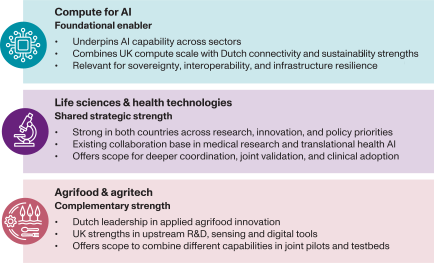
This briefing is part of a wider analysis organised around three priority sectors for UK–Netherlands AI ecosystems: (1) compute for AI, (2) life sciences and health technologies and (3) agrifood and agritech. These sectors were selected because they capture different but complementary forms of bilateral opportunity and can demonstrate a strong industrial foundation and policy prioritisation in both countries. Compute functions as a foundational enabler of wider AI capability and resilience; life sciences and health technologies represent an area of shared strategic strength, with strong research, innovation and policy alignment in both countries; and agrifood and agritech represents a domain of complementary advantage, combining Dutch applied leadership with UK strengths in R&D and digital innovation.
Life sciences and health technologies are a clear area of shared strategic strength within the UK and Dutch AI ecosystems. The sector is well developed in both countries, supported by strong research and innovation institutions and identified as a national policy priority. Patent and publication analysis shows that medical or veterinary science and hygiene account for the largest share of AI-related patenting in both countries, with around 44,000 documents in the UK and 16,000 in the Netherlands, while medicine is also one of the leading fields of AI-related publication activity.
Across both ecosystems, AI is expected to improve diagnostics, support more personalised medicine and increase efficiency in care delivery, while helping relieve pressure on health systems and workforces. An existing foundation of strong technological innovation and research activity supports the implementation of this ambition in both countries
At the same time, the two countries differ in strategic orientation. The UK places greater emphasis on global competitiveness, commercial scale and attracting foreign direct investment, while Dutch strategies are more cautious, emphasising responsible innovation within European frameworks.
This creates a strong basis for deeper bilateral cooperation, particularly where shared strengths can be translated into coordination and the validation and adoption of AI-enabled technologies.
Both countries treat AI in the life sciences and health as a strategic priority, but with different emphases. The UK focuses more on competitiveness, productivity and NHS transformation, while the Netherlands places greater weight on relieving workforce pressure and operating within European frameworks. Both face similar barriers, including fragmented health data, uneven readiness for adoption, and regulatory and clinical-trial processes that slow deployment. Although the UK is outside EU frameworks, broad alignment remains. New EU initiatives, including the European Health Data Space (EHDS) and the EU Pharmaceutical Reform, could create opportunities for continued alignment but may also increase the risk of divergence over time.
Why this matters: Despite different priorities and strategic orientations, the UK and the Netherlands are aligned in seeing AI in life sciences and health as a source of both economic value and as a tool to improve their health systems. Fostering engagement between similar initiatives such as the EHDS and the UK’s Health Data Research Service (HDRS) – as well as wider policy and ethics dialogues on data governance and regulatory frameworks – could provide support and momentum for continued alignment between the two countries.
As the larger and more globally competitive ecosystem, the UK attracted $4.1bn in life sciences VC in 2025 and aims to strengthen its position as a leading destination for life sciences investment. Major UK market actors include Google DeepMind and its connected venture in AI-enabled drug discovery Isomorphic Labs, alongside large pharmaceutical companies such as AstraZeneca and a broader base of AI-focused biotech firms. The Netherlands’ ecosystem is smaller, attracting $822m in life sciences VC in 2025 but offering an ecosystem with established health technology innovators, particularly Philips.
Firms face similar commercial risks in both countries, including fragmented access to health data, uneven readiness for adoption in care settings, and regulatory and clinical-trial processes that can slow deployment and scale-up. In the UK in particular, fragmentation across NHS trusts and unequal access to resources at trust level remain significant barriers to more consistent adoption.
Why this matters: For AI-enabled life sciences firms the UK is better positioned as a platform for scale and international market development, while the Netherlands can provide more direct access to European clinical, regulatory and market pathways. Because firms face many of the same AI-related barriers in both ecosystems there is also scope for shared learning and cross-border problem solving.
Across the wider AI landscape, 5,885 joint UK–Netherlands publications in the sector were identified between 2016 and 2026. Joint activity between leading UK institutions such as University College London, Imperial College and Oxford University with Dutch university medical centres (UMCs) such as UMC Groningen, Erasmus MC and UMC Utrecht stands out. Life sciences and health are also prominent in publishing in each country. Medicine is a leading AI publication field in both ecosystems, with around 29,000 publications in the UK and 13,000 in the Netherlands.
The two systems differ in profile. The UK contributes greater scale, international visibility and a dense concentration of leading universities and biomedical research centres, while the Netherlands offers a more clinically embedded model in which UMCs play a central role in linking research, patient care and training.
Existing collaboration provides a strong foundation on which to build engagement. With strong research capacity and knowledge in both ecosystems there is potential to create value in fostering greater exchange and creating incentives for resource, data and knowledge sharing, as well as trialling research findings across different clinical settings.
The opportunities below are primarily areas where policy and institutional support could strengthen the conditions for collaboration between researchers, firms and clinical actors in both countries. Some, such as exchanges, networking and joint training, are also directly relevant to external stakeholders in the near term. Others, particularly those related to interoperability and data governance, are more likely to depend on coordinated policy action and longer-term institutional alignment.

This publication is part of the RAND research brief series. Research briefs present policy-oriented summaries of individual published, peer-reviewed documents or of a body of published work.
This document and trademark(s) contained herein are protected by law. This representation of RAND intellectual property is provided for noncommercial use only. Unauthorized posting of this publication online is prohibited; linking directly to this product page is encouraged. Permission is required from RAND to reproduce, or reuse in another form, any of its research documents for commercial purposes. For information on reprint and reuse permissions, please visit www.rand.org/pubs/permissions.
RAND is a nonprofit institution that helps improve policy and decisionmaking through research and analysis. RAND's publications do not necessarily reflect the opinions of its research clients and sponsors.